Sunderland Greyhound Results — Complete Race Data, Track Guide & Analysis
Every race. Every time. Every trap.Best Horse Racing Betting Sites – Bet on Horse Racing in 2026
 Available in US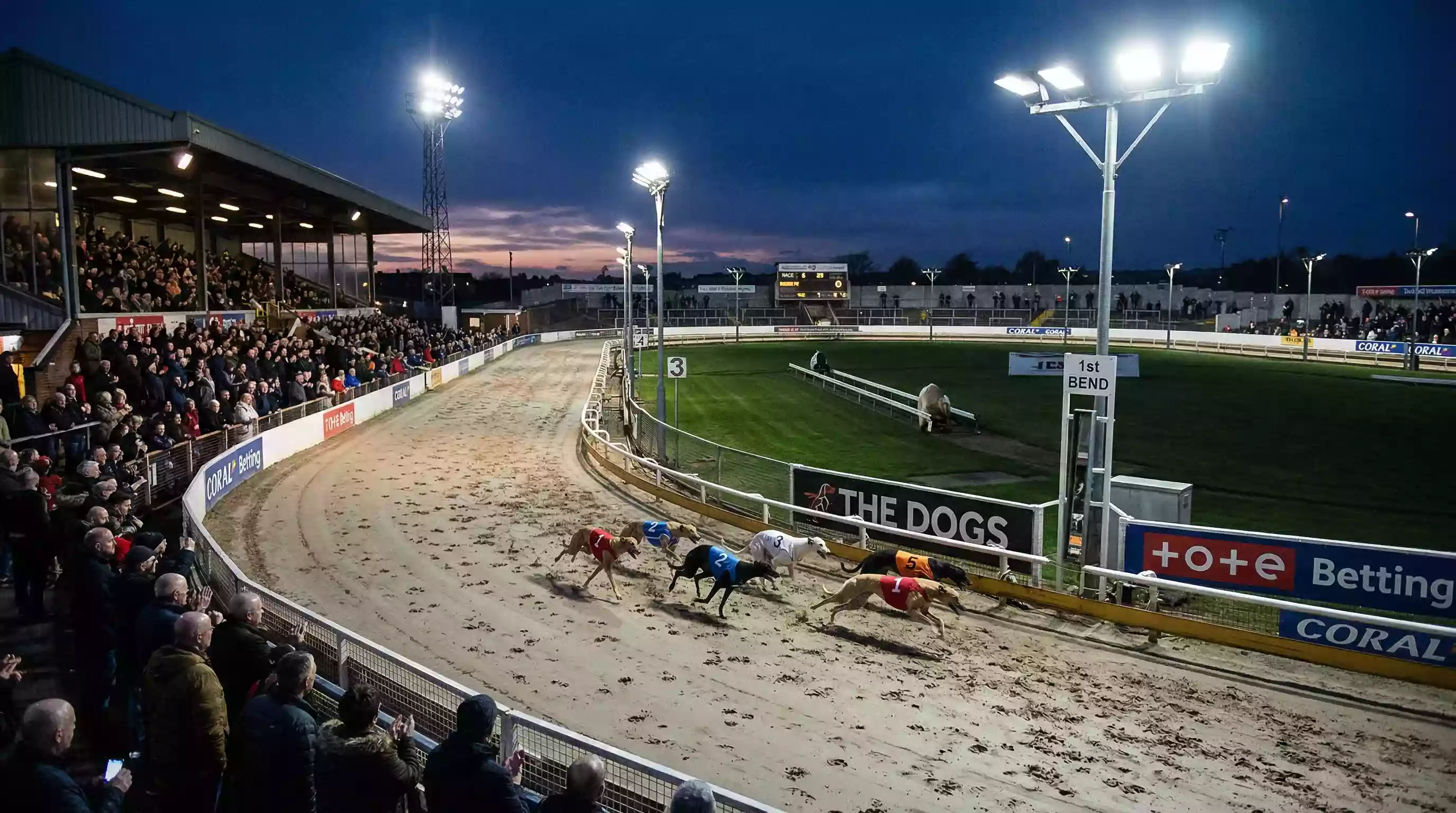
Sunderland greyhound results appear more frequently than most people outside the sport realise. The stadium in Boldon, Tyne and Wear, runs five fixtures every week — Friday evening open racing, a Sunday afternoon card, and three midweek meetings contracted through the BAGS (Bookmakers' Afternoon Greyhound Service) system. That volume means fresh results data flows out of Sunderland on most days of the year, making it one of the busiest tracks in North East England and one of the most consistent sources of greyhound form across all four racing distances: 261, 450, 640 and 828 metres.
For bettors, that density is both an opportunity and a challenge. More races mean more data points, more patterns to track, and more chances to spot value — but only if you know where to find the results, how to read them, and what the numbers behind each race actually represent. For casual visitors heading to the stadium on a Friday night, the same data tells a different story: which races are worth watching, what the distance of a race implies about the style of contest, and why two dogs clocking the same finish time on different evenings might not be running at the same level at all.
This page pulls together everything a serious follower of Sunderland greyhound racing needs in one place. It covers the track itself — dimensions, hare type, capacity — alongside the practical question of where to access results online, how to decode the abbreviations in a standard UK racecard, and what each of the four distances demands from a greyhound. There are sections on BAGS racing and its influence on the Sunderland schedule, plus a concise history of a stadium that has been hosting competitive racing since 1940. If you already know the sport, treat this as a reference hub. If you are new, it is a structured way in.
Sunderland at Five Fixtures a Week — What Matters Most
- Sunderland runs five meetings per week across four distances (261 m, 450 m, 640 m, 828 m), producing one of the richest result datasets of any UK track.
- The 640 m track record stands at 38.79 seconds, set by New Destiny in April 2025 — a benchmark for middle-distance form analysis.
- Official results are available through the stadium site, Sporting Life, Racing Post and Timeform, each with different depth and delay trade-offs.
- UK greyhound racing celebrates its centenary in 2026, and Sunderland — open since 1940 — remains one of only 18 GBGB-licensed tracks still operating.
- Understanding BAGS meetings, going allowances and in-running abbreviations separates recreational punters from those who consistently find value in the data.
UK Greyhound Racing at a Glance
Before diving into Sunderland specifically, it helps to understand the scale and shape of the sport it belongs to. UK greyhound racing in 2026 is smaller than it was at its mid-century peak, but it remains a meaningful part of the national sporting and betting landscape — bookmaker turnover on greyhound racing reached £794 million in the 2023–24 reporting period (Gambling Commission data) — and the numbers show a sector that has, in many measurable ways, improved its standards in the last decade.
As of January 2025, there are 18 GBGB-licensed greyhound stadiums operating across Great Britain, none in Scotland (the last licensed Scottish track, Shawfield, suspended racing in March 2020 and never reopened) and a single track in Wales — Valley — which faces a legislative ban sometime between 2027 and 2030. The licensed sector employs around 500 trainers, approximately 3,000 kennel staff and roughly 700 track officials. Some 15,000 individuals are registered as greyhound owners, and around 6,000 greyhounds are newly registered for racing each year. These figures reflect a sport that, while compact compared to horse racing, supports a genuine workforce and a deep participant base.
The year 2026 is a landmark one. On 24 July 1926, the first official greyhound race under rules took place at Belle Vue stadium in Manchester — a greyhound named Mistley won a 440-yard dash in 25.00 seconds in front of 1,700 spectators. A century later, GBGB's "100 Years on Track" campaign marks the occasion with events across the calendar, and Sunderland, as one of the sport's surviving Category One venues, sits firmly in that centenary narrative.
18 Licensed Stadiums
GBGB-licensed tracks operating in Great Britain as of early 2025, down from 77 licensed venues in the 1940s.
6,000 Greyhounds Registered Per Year
Newly registered racing greyhounds annually, supported by 500 trainers and 15,000 owners.
1.07% Injury Rate
The lowest recorded injury rate in licensed UK greyhound racing history — 3,809 injuries from 355,682 individual runs in 2024.
94% Successfully Rehomed
Of greyhounds leaving the sport in 2024, 5,795 were successfully homed — up from 88% in 2018.
Welfare data deserves particular attention because it shapes public perception and regulatory outcomes for the entire sport. In 2024, GBGB recorded 3,809 injuries across 355,682 individual runs — an injury rate of 1.07%, the lowest on record. The fatality rate on track dropped to 0.03%, half of what it was in 2020. Economic euthanasia — the practice of putting down a healthy greyhound because no home could be found — fell from 175 cases in 2018 to just three in 2024. And 94% of greyhounds leaving the sport (5,795 dogs) were successfully rehomed, compared with 88% six years earlier.
"There is much to be pleased and encouraged by in this year's data," said Mark Bird, Chief Executive of GBGB. "It shows that the initiatives we have introduced in recent years are now embedded and are helping to consolidate the significant progress we have made since 2018 across all measures."
Whether those numbers satisfy critics of the sport is a separate debate. What they do provide is context: the licensed racing environment that generates Sunderland's results is one with a documented welfare framework and publicly available performance data, not an opaque backroom operation.
On the commercial side, attendance at Arena Racing Company (ARC) greyhound stadiums grew by 5% in 2025, bucking a broader trend of declining footfall in live sports entertainment. "Competition for the leisure pound has never been higher, so to grow our footfall in 2025 is a great achievement," noted Sarah Newman, Marketing and Communications Manager at ARC. That growth was not evenly distributed — Newcastle's All England Cup final saw an 85% attendance spike — but it signals that at least some tracks are pulling in bigger crowds, not smaller ones.
UK greyhound racing enters its centenary year with 18 licensed stadiums, improving welfare metrics, and modest but real attendance growth. Sunderland sits within this framework as one of the sport's most active venues.
Sunderland Stadium Profile
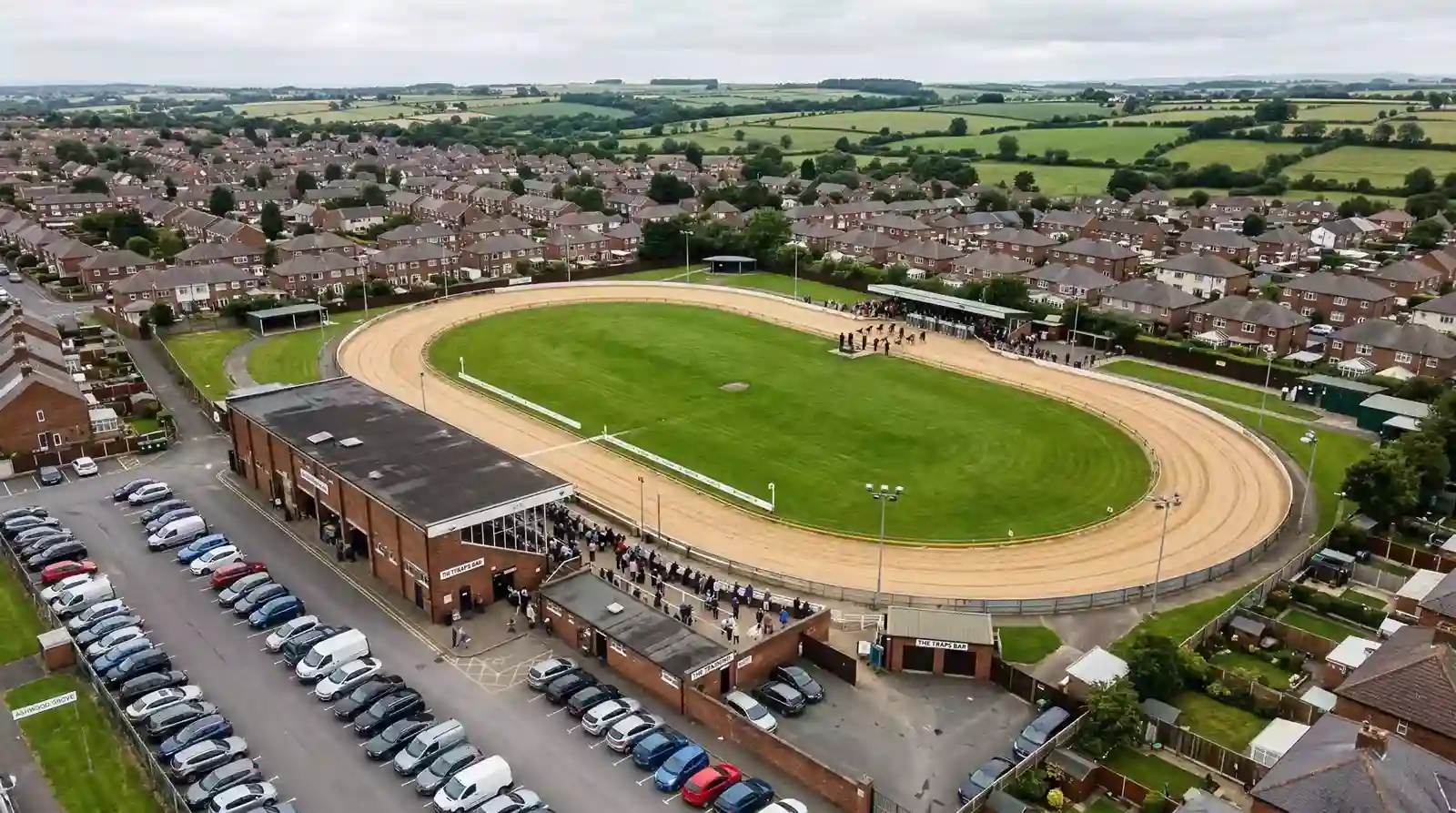
Sunderland Greyhound Stadium sits on a compact site at Boldon, between the city centre and the coast. It is not the largest track in the ARC portfolio, but it punches above its weight on the racing calendar: five fixtures a week, two Category One competitions, and a schedule that keeps the form book ticking over nearly every day of the year.
Track Dimensions and Layout
The track circumference is 379 metres, placing it in the mid-range for UK greyhound circuits. It races over four distances — 261, 450, 640 and 828 metres — which between them cover sprint, standard, middle-distance and staying categories. The run-up to the first bend is 93 metres from the 450-metre boxes and 84 metres from the 640-metre start, a difference that matters more than it sounds: a shorter run-up compresses the pack earlier and tends to reward dogs who trap cleanly, while the longer run from the 450 boxes gives railers and wide runners slightly more time to establish their position.
The hare system is an Outside McGee, which means the lure travels on the outside of the track. That has implications for trap draws and running lines — dogs in wider traps have a marginally more natural sightline to the hare — but the effect is less dramatic than at some circuits because of the track's relatively generous early straight.
Capacity and Facilities
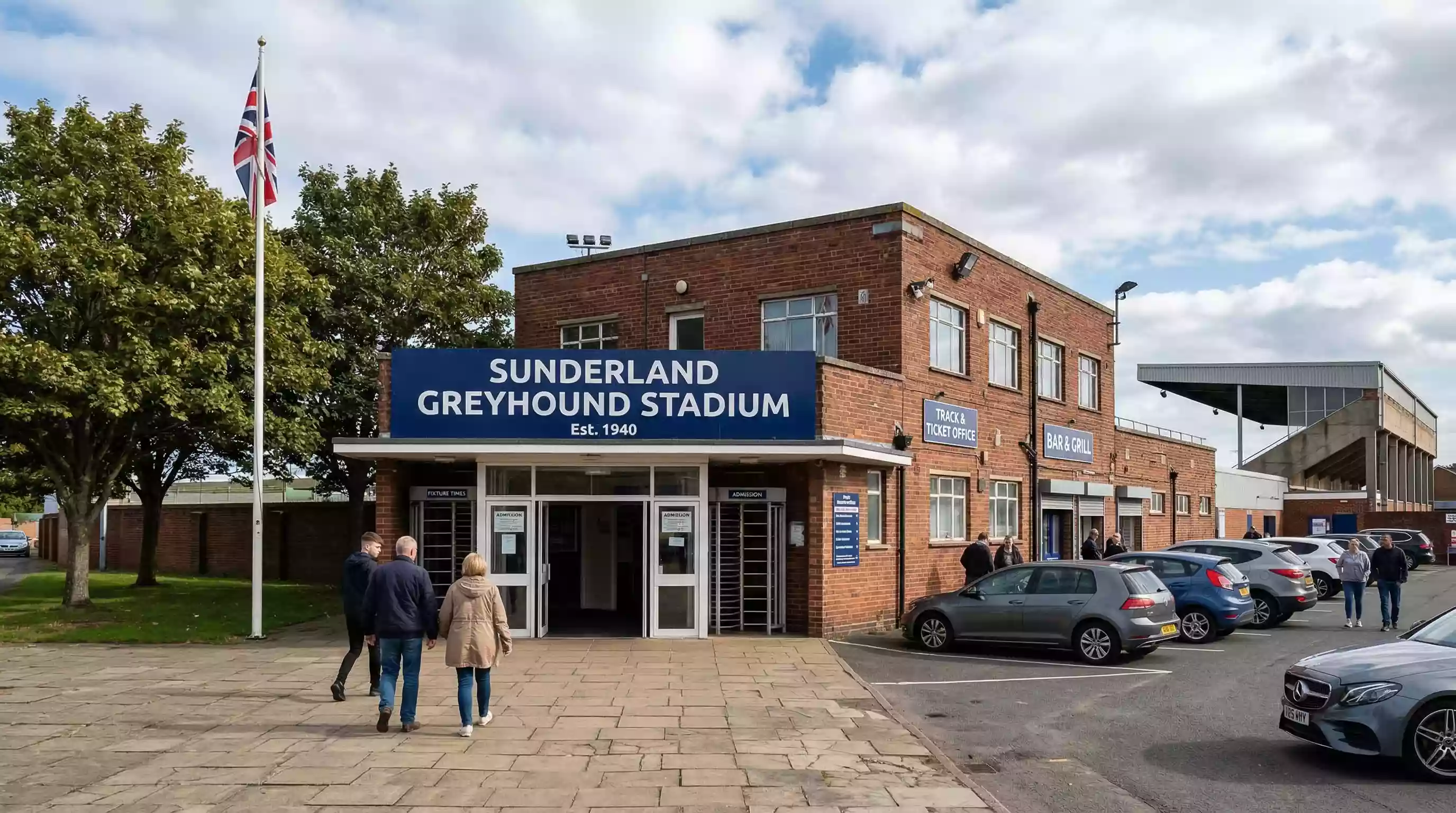
Official capacity is 1,500 spectators. There is parking for 500 cars on-site, free of charge, which is enough for most standard fixtures but can fill up on Category One final nights and seasonal events. The stadium has a restaurant area serving meal-and-racing packages and a trackside viewing zone for those who prefer to stand closer to the action. Accessibility provisions are available, though the venue's age — it was built in 1940 — means it does not have the ground-up accessible design of newer facilities.
The Racing Calendar
Sunderland's weekly schedule comprises five fixtures. Friday evening is the flagship open meeting, typically starting around 18:30, and it draws the best-graded dogs and the largest trackside crowd. Sunday afternoon offers a second open meeting in a more relaxed daytime setting. The remaining three fixtures — Monday, Wednesday, and sometimes Thursday — are BAGS meetings, contracted through the Bookmakers' Afternoon Greyhound Service, which supplies content to licensed betting shops and online platforms. These BAGS meetings run during the day and tend to feature slightly lower-graded fields, but they still produce full results with sectional data and in-running commentary.
The stadium hosts two Category One competitions: the Premier Greyhound Racing Classic, which awards £20,000 to the winner, and the ARC Grand Prix, carrying a £12,500 first prize. Both draw runners from across the country and represent the highest competitive tier staged at Sunderland.
"For families and groups of friends or colleagues yet to experience live greyhound racing, we'd highly recommend a visit trackside," said Joanne Wilson, General Manager at Sunderland Greyhound Stadium. "The action is fast and there are plenty of opportunities to meet the stars of the track."
Sunderland's 379-metre circuit runs four distances across five weekly meetings. Two Category One competitions — the Classic and Grand Prix — elevate its status beyond a local venue.
Where to Find Sunderland Results Online
Results from Sunderland are available from multiple sources, each with a slightly different depth, format and speed of publication. The choice depends on whether you need raw finishing positions five minutes after a race, or fully annotated result cards with sectional times and in-running comments the following morning.

Official Stadium Website
The Sunderland Greyhound Stadium site at sunderland-greyhounds.co.uk publishes results as downloadable PDF racecards. These are authoritative — they come directly from the track — and they include trap draws, finishing positions, winning distances, race times, and going data. The drawback is format: PDFs are not searchable in the way a database is, and they are typically uploaded the morning after a meeting rather than in real time.
Sporting Life
Sporting Life offers a clean, browser-friendly results interface. Results appear quickly — usually within an hour of a meeting finishing — and the layout is straightforward: race-by-race results with times, distances, and starting prices. For regular bettors who want to scan results without downloading files, it is the most accessible free option. It lacks some of the deeper form data that specialist services carry, but for checking winners and times it does the job efficiently.
Racing Post
The Racing Post provides the most detailed form data of any mainstream source. Results include RPR (Racing Post Rating), going allowance adjustments, trainer records, and historical form sequences. Some of this depth sits behind a paywall, but even the free tier gives more analytical context than most alternatives. If you are doing serious form study — comparing runs across different meetings and distances — this is the platform that rewards sustained use.
Timeform
Timeform applies its own proprietary rating system to greyhound results. The value here is in the comparative analysis: Timeform ratings allow you to compare dogs across different tracks and distances with a standardised metric. The trade-off is cost; full access requires a subscription. For bettors who work across multiple tracks rather than following Sunderland exclusively, the cross-venue rating system justifies the expense.
At The Races and SIS
These broadcast-linked platforms carry Sunderland results alongside live streaming feeds. They tend to be fastest for in-running data during BAGS meetings, because the same organisation (SIS, in many cases) provides both the live broadcast to betting shops and the results feed. If you are watching a race live via an online stream, the result often populates on the same platform within minutes.
| Source | Speed | Depth | Cost | Best For |
|---|---|---|---|---|
| Official site (PDF) | Next morning | Full racecard | Free | Archival reference |
| Sporting Life | Within 1 hour | Standard | Free | Quick checks |
| Racing Post | Within 1 hour | Deep form + RPR | Freemium | Form study |
| Timeform | Within 2 hours | Proprietary ratings | Subscription | Cross-track comparison |
| At The Races / SIS | Near-live | Basic + stream | Via bookmaker | Live viewing |
No single source does everything. The practical approach for a regular Sunderland follower is to use Sporting Life or At The Races for same-day results, the official site for verified racecard data, and Racing Post or Timeform for deeper form analysis when preparing for upcoming meetings.
Reading Sunderland Results — A Quick Primer
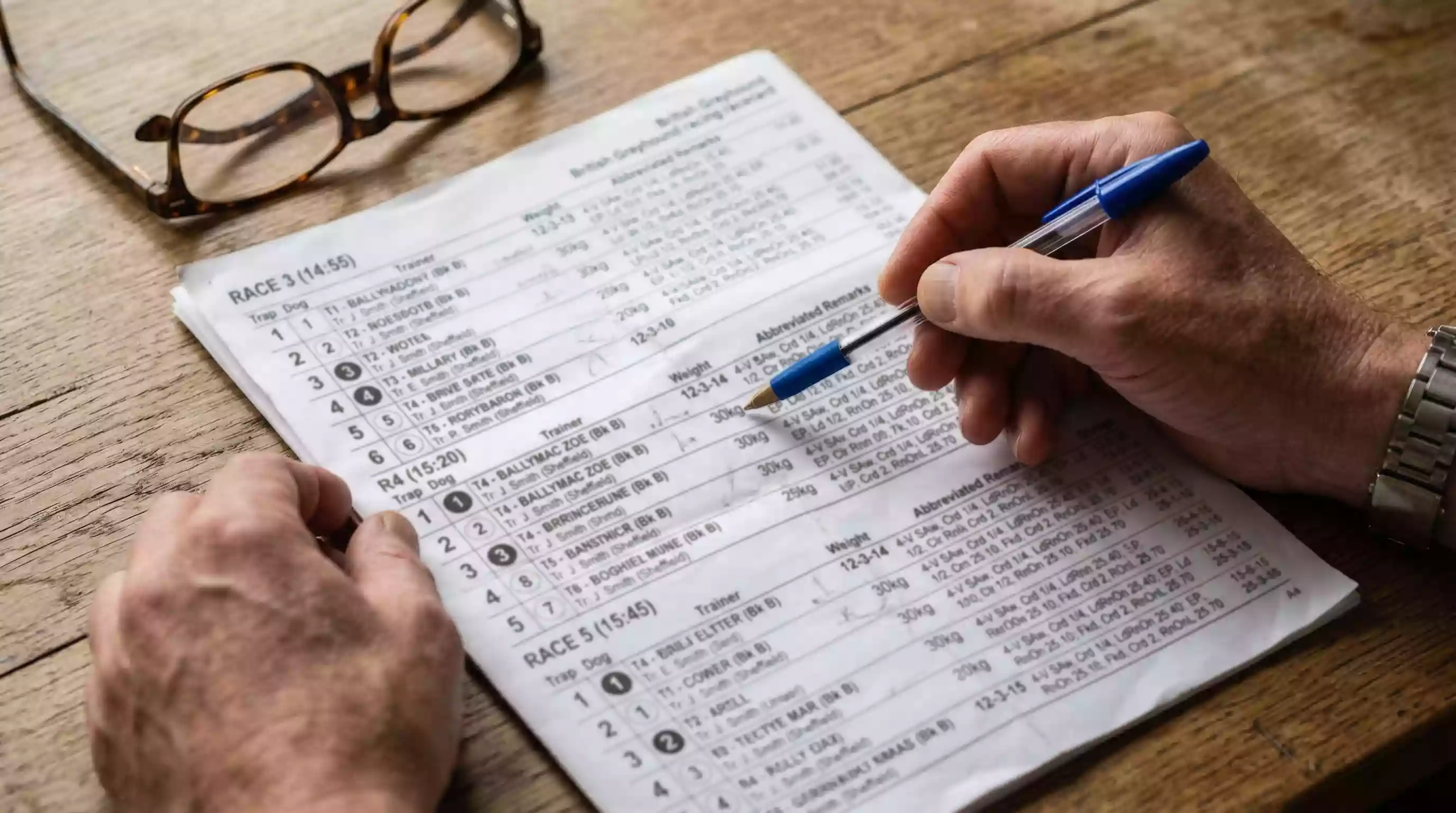
A Sunderland result card, like any UK greyhound result, is a compressed data record. Each line packs in a dog's finishing position, trap number, in-running comments, race time, starting price, trainer, and sometimes a weight and a calculated time. If you have never read one before, it looks like a wall of abbreviations. Once you know the conventions, it reads like a short story about what happened between the traps opening and the winning line.
Trap Colours and Starting Position
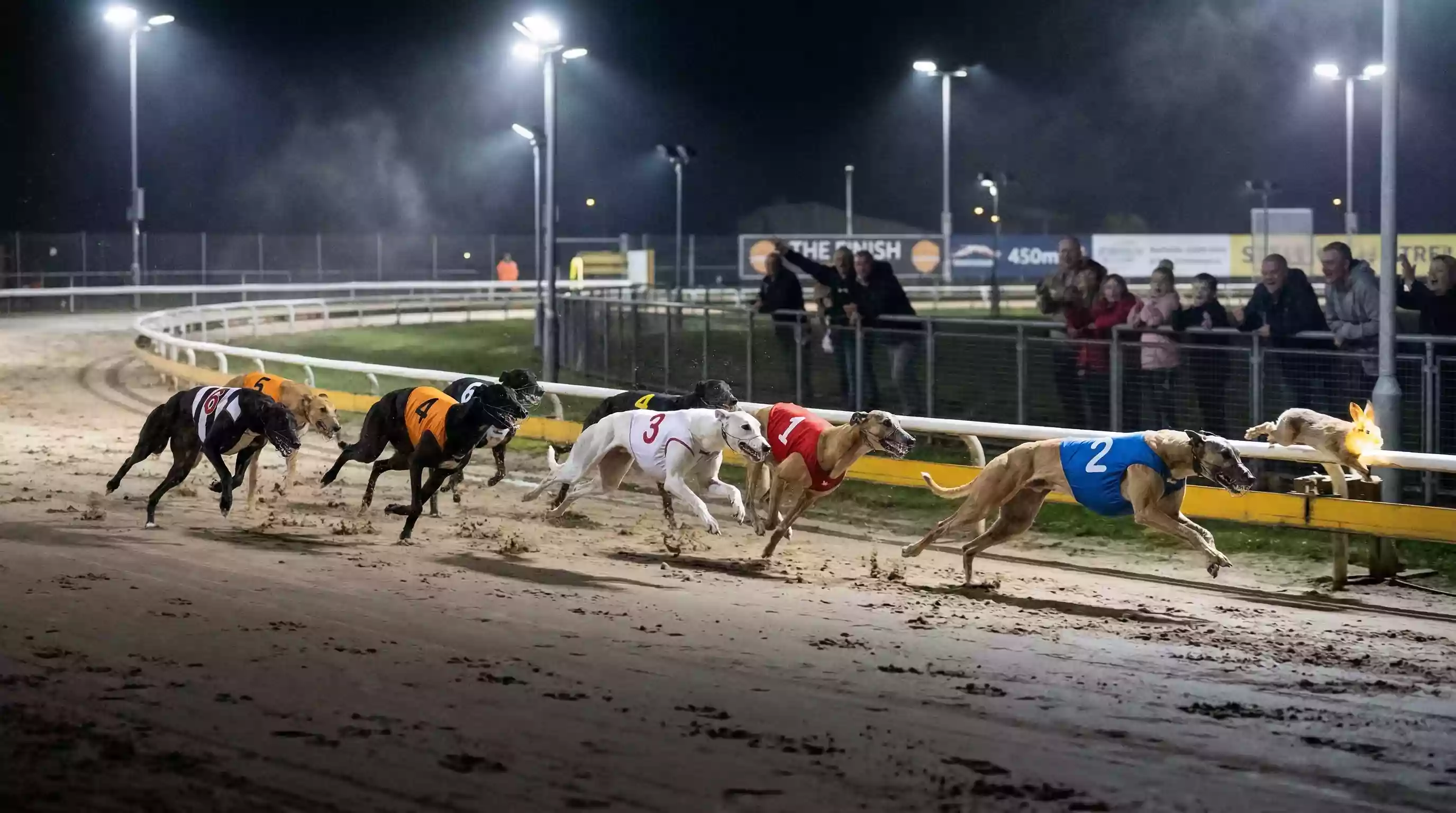
Every greyhound runs from a numbered trap — 1 through 6 — and each trap has a colour. Trap 1 is red, trap 2 blue, trap 3 white, trap 4 black, trap 5 orange, trap 6 black and white stripes. These colours appear on the jacket the dog wears during the race and are the fastest way to identify a runner on a live stream or from the trackside. In a result card, the trap number tells you where the dog started, which matters for analysing how the race unfolded relative to rail position and hare line.
In-Running Abbreviations
The comment line on a result card is where the real story lives. These abbreviations describe how a dog ran from start to finish, and reading them correctly separates a glance at the result from genuine form analysis. The most common codes you will encounter on a Sunderland card include:
- SAw — Slow away. The dog was sluggish out of the trap. This is one of the most important indicators: a dog that finishes third after a slow start may have more ability than the result suggests.
- EP / EPace — Early pace. The dog showed speed in the first section of the race. At Sunderland's 261-metre sprint, early pace is almost everything; over 828 metres, it is less decisive.
- MsPace — Mid-straight pace, referring to speed through the middle phase of the race.
- Crd — Crowded. The dog was impeded by other runners. Like SAw, this is an excuse note: a crowded dog may well run better next time with a cleaner trip.
- Bmp — Bumped. Physical contact with another runner, less severe than Crd but still a factor.
- Ld — Led. The dog was in front at some point during the race, usually specified with a section (Ld1, Ld2, etc.).
- RnIn — Ran in. The dog drifted inwards towards the rail, potentially interfering with another runner's line.
- RnOn — Ran on. The dog finished strongly. Over longer distances at Sunderland — 640 and 828 metres — this note suggests staying power.
These abbreviations are standardised across all GBGB tracks, so learning them at Sunderland means you can read results from any licensed UK venue without relearning the language.
Race Time, Going, and Calculated Time
The race time on a result card is the clock time from traps to the winning line. Straightforward enough — but it does not tell the whole story. Track conditions vary from meeting to meeting: a surface that has been watered runs slower than a dry one, and rain during racing changes the going mid-card. To account for this, UK greyhound results include a "going allowance" — a positive or negative adjustment, expressed in hundredths of a second, that reflects how fast or slow the surface was compared to standard.
The calculated time (CT) applies this allowance to produce a standardised time. If a dog wins a 450-metre race in 27.65 seconds on a night where the going allowance is +20 (meaning the track was slow), its CT would be 27.45 seconds. Calculated time is the number you use to compare performances across different meetings, because it strips out the variable of track conditions. Without it, you would be comparing apples with oranges every time you looked at a result from a dry Friday versus a wet Wednesday.
Starting Price and Form Sequence
The starting price (SP) is the odds at which the dog went off. It is a consensus market view of each runner's chances, and while it is not infallible — favourites in graded UK greyhound racing win roughly 35.67% of the time, meaning they lose about two-thirds of their races — it is the quickest proxy for how the market rated a dog's chances on the night. The form sequence, usually shown as a string of numbers and letters representing the last six runs, tells you whether that market confidence was justified by recent performances or whether the dog was fancied on reputation alone.
In-running abbreviations, going-adjusted calculated times, and form sequences are the three pillars of reading a Sunderland result. Master them, and every result card becomes a form analysis tool rather than a list of finishers.
Distance by Distance — What the Numbers Mean
Sunderland's four distances produce four fundamentally different types of race. The sprint at 261 metres is over in less than 16 seconds. The staying trip at 828 metres takes close to 53 seconds and covers more than two full laps. Between them, 450 and 640 metres represent the core of the Sunderland card, accounting for the majority of races at every meeting. Understanding what each distance demands — and what typical times look like — is essential for reading Sunderland greyhound results with any precision.
261 Metres — The Sprint
The shortest trip at Sunderland is barely more than a straight dash plus one bend. Races over 261 metres are decided almost entirely by trap speed and early pace. A dog that is half a length slow out of the boxes at this distance has almost no time to recover, because the winning line arrives before the tactical phase of a longer race would even begin. Typical winning times sit between 15.5 and 16.5 seconds depending on the going, and margins are often measured in necks rather than lengths. Sprint results reward bettors who focus on a dog's recent trapping record rather than its overall form. A greyhound with three SAw (slow away) comments in its last six runs is a poor prospect here, regardless of how fast it finishes over longer distances.
450 Metres — The Standard
This is the bread-and-butter distance of UK greyhound racing and the one that appears most frequently on a Sunderland card. A 450-metre race covers roughly one and a quarter laps, which means the pack negotiates two bends and a back straight before the home stretch. Winning times typically range from 27.0 to 28.5 seconds. The run-up to the first bend from the 450-metre boxes is 93 metres — generous enough to give inside and outside runners time to find their positions, but short enough that trap speed still matters. This is the distance where overall balance is most important: a dog needs to trap reasonably well, hold its position through two bends, and have enough finish to sustain pace to the line.
640 Metres — Middle Distance
The 640-metre trip adds a full additional lap compared to the standard, and it is where the complexion of racing at Sunderland changes most noticeably. Speed matters less; stamina and racing intelligence matter more. Dogs that can settle in behind the early pace and pick up through the closing stages tend to outperform raw speedsters who use up their energy by the halfway mark. The run-up from the 640-metre boxes is 84 metres — shorter than the 450 start — which can compress the field early and produce more crowding through the first bend.
The current track record at 640 metres is 38.79 seconds, set by New Destiny on 18 April 2025 during the ARC Grand Prix. That run broke a record that had stood since Coolavanny Aunty's performance in April 2022. The 38-second barrier at this distance is a benchmark that only genuinely high-class middle-distance dogs reach, and New Destiny's time remains the standard by which other 640-metre performances at Sunderland are measured.
828 Metres — The Staying Trip
The longest distance at Sunderland covers more than two full laps of the circuit. Staying races are the least common on a standard card, but they produce some of the most tactically interesting contests. Over 828 metres, a dog's running style becomes paramount. Early-pace greyhounds that blaze from the traps often fade in the final quarter-lap, while patient runners that conserve energy and accelerate late have a structural advantage. Typical winning times fall between 52 and 54 seconds, though variation is greater here than at shorter trips because the cumulative effect of the going is magnified over the extra distance.
For bettors, the staying trip is where the in-running comments on previous results become most valuable. A dog noted as "RnOn" (ran on) in recent 640-metre races is signalling that it has more to give over further — a useful indicator when that same dog steps up to 828 metres. Conversely, a string of "EvPace" (even pace) comments over shorter distances might simply mean the dog lacks the late acceleration to sustain a challenge over two full laps.
| Distance | Typical Time Range | Key Factor | Run-Up to First Bend |
|---|---|---|---|
| 261 m | 15.5–16.5 s | Trap speed | Short (sprint start) |
| 450 m | 27.0–28.5 s | Balance | 93 m |
| 640 m | 38.5–40.5 s | Stamina + intelligence | 84 m |
| 828 m | 52–54 s | Running style + staying power | Full lap start |
Each of Sunderland's four distances tests a different set of attributes. Sprint results are determined before the first bend; staying results are shaped by what happens over two full laps. Treating all distances the same when reading the form book is the single most common analytical mistake.
BAGS Meetings and What They Mean for Sunderland
Three of Sunderland's five weekly fixtures are BAGS meetings, which makes the system central to understanding the results data the track produces. BAGS — the Bookmakers' Afternoon Greyhound Service — is the mechanism through which licensed betting shops in the UK receive live greyhound content during the day, and it has been a cornerstone of the sport's commercial model for nearly six decades.
What BAGS Actually Is
BAGS was founded in 1967 to give betting shops a steady stream of racing content during afternoon hours when horse racing was not always available. The principle is straightforward: bookmakers contract with stadiums to provide a set number of races per meeting, broadcast live to shops and online platforms via SIS or other media providers. The bookmakers fund prize money and appearance fees; the stadiums supply the venue, the dogs and the operational infrastructure.
The scale of BAGS today is substantial. Across UK tracks, the system generates approximately 28,000 races per year, spread across around 74 meetings every week. That makes BAGS-contracted racing the single largest source of greyhound results in the country — far exceeding open racing in sheer volume, even if open meetings tend to feature stronger fields.
How BAGS Affects Sunderland's Results
At Sunderland, the Monday, Wednesday and (sometimes Thursday) afternoon meetings are BAGS fixtures. They typically start earlier in the day — mid-morning or early afternoon — and the fields are drawn from a slightly different pool than the Friday and Sunday open meetings. Open races are graded by the stadium's racing manager to produce competitive six-dog fields based on form; BAGS fields are graded too, but the priority is also to ensure that a full card can be filled reliably each week, which sometimes means mixing dogs of different class levels within a single meeting.
For bettors who follow Sunderland greyhound results, this distinction matters. A BAGS meeting might produce finish times that look slower than Friday's card, but that does not necessarily mean the dogs are slower — it might reflect a lower-graded race where the pace is less intense, or a meeting on different going. The smart approach is to compare BAGS results against other BAGS results and open results against open results, rather than pooling them together without context.
From the sport's financial perspective, BAGS provides the economic baseline that keeps most UK tracks operational. Without the guaranteed revenue from bookmaker contracts, many stadiums — including smaller venues with limited trackside attendance — would struggle to remain viable. "Whilst the number of stadia has over time reduced, the opposite is true as to the number of races staged," observed Joe Scanlon, Chairman of the British Greyhound Racing Fund. "With two content suppliers, ARC and SIS vying for both retail and online bookmaker customers, the impact on greyhound numbers is reaching a critical stage."
That tension between volume and welfare — more races mean more revenue, but also more physical demands on the greyhound population — is one of the defining debates in UK greyhound racing in 2026. For a results-focused reader, the practical takeaway is simpler: when you see Sunderland results from a Monday or Wednesday afternoon, you are looking at BAGS content produced for the betting market, and the grading, field quality and competitive dynamics may differ from the open meetings that draw a trackside audience. The fact that Sunderland has maintained this five-day schedule for years speaks to the stadium's durability — a quality that runs through its entire eight-decade history.
Interactive Tool
BAGS Races Per Meeting, and Classic vs Grand Prix
Calculate the average number of races per BAGS meeting nationally, and compare Sunderland's two Category One prize funds.
Races Per BAGS Meeting
-
-
Races Per Year
-
Weekly Meetings
-
Annual Meetings
-
What this guide gives as an annual total and a weekly count without the average: "the system generates approximately 28,000 races per year, spread across around 74 meetings every week." Races per meeting is never calculated — it's roughly 7.3 races per meeting nationally, across an estimated 3,848 meetings a year.
Grand Prix as % of Classic
-
-
Premier Classic
-
ARC Grand Prix
-
Difference
-
What this guide gives as two prize amounts without the comparison: "the Premier Greyhound Racing Classic, which awards £20,000 to the winner, and the ARC Grand Prix, carrying a £12,500 first prize." The ratio is never calculated — the Grand Prix pays 62.5% of the Classic, a gap of £7,500.
BAGS generates around 74 meetings per week across UK tracks — meaning on any given weekday, there are roughly 15 greyhound meetings happening somewhere in Great Britain, the vast majority of them contracted to supply content to betting shops.
From 1940 to the ARC Era — Sunderland's Racing Story
Sunderland Greyhound Stadium has been in continuous operation for 85 years, which makes it one of the longest-surviving venues in a sport that has seen dozens of tracks come and go. The history is not just nostalgic filler — it explains why the track is the shape it is, who owns it, and how it ended up as one of only 18 licensed stadiums still standing.
Opening Night: 23 March 1940
The stadium opened on 23 March 1940, built at a cost of £60,000 — a considerable sum in wartime Britain. The design came from the architectural firm Matkin & Hawkins. Greyhound racing was booming in that era: attendance across the country had grown from 5.5 million in 1927 — just a year after the first official race at Belle Vue — to 16 million by 1929, and even the disruption of the Second World War did not kill demand. The 1940s saw 77 licensed tracks operating alongside more than 200 independent (flapping) venues, a density of greyhound racing that is difficult to imagine from a 2026 perspective.
Sunderland was built as a purpose-designed greyhound venue, not a converted athletics ground or a shared-use site. That mattered because the track geometry — the circumference, bend cambers, run-up distances — was optimised for racing from day one, and the basic layout has been retained through multiple ownership changes and refurbishments.
The Speedway Decade: 1964–1974
For ten years from 1964, the stadium did double duty as a speedway venue. Three teams raced there over the decade — the Saints, the Stars and the Gladiators — and the venue drew speedway crowds of up to 6,500 spectators, figures that exceeded the greyhound attendance by a significant margin. Managing a dual-use track was logistically complex: speedway shale and greyhound sand have different surface requirements, and scheduling had to accommodate two distinct racing calendars. By 1974, the economics no longer worked, and speedway left Sunderland for good. The stadium reverted to greyhound-only operation, which it has maintained ever since.
William Hill and the Corporate Era
In September 2002, William Hill acquired Sunderland stadium for £9.4 million — the first time a national bookmaker had purchased a greyhound venue outright. The acquisition reflected a broader trend of consolidation in the sport: independent family-owned tracks were being replaced by corporate operators with the capital to invest in facilities but also the commercial imperative to extract maximum betting revenue. William Hill ran the stadium for 15 years, during which the venue continued to host regular racing but did not see major structural redevelopment.
The ARC Takeover: 2017 to Present
Arena Racing Company took over Sunderland (and neighbouring Newcastle) from William Hill in May 2017. ARC is the UK's largest combined racing operator, running 16 horse racing courses and five greyhound stadiums. Under ARC ownership, Sunderland gained Category One status, secured the Premier Classic and Grand Prix fixtures, and benefited from the company's broader investment in marketing and digital broadcasting. The stadium's five-fixture weekly schedule has been maintained, and the 2025 attendance figures — part of ARC's reported 5% group-wide growth — suggest the venue is at least holding its audience in a shrinking market.
The broader historical context is worth noting: between the 1960s and 2010, 91 licensed greyhound tracks closed across the UK. Sunderland survived that cull, and in 2026 it enters the centenary year of British greyhound racing as one of the sport's established and active venues.
When Sunderland opened in 1940, there were 77 licensed greyhound tracks in Great Britain plus more than 200 unregulated "flapping" venues. By 2025, only 18 licensed stadiums remained — meaning Sunderland has outlasted roughly 96% of the tracks that were operating when it first opened its gates.
"Winning the Grand Prix at Sunderland was the best feeling I've experienced," recalled trainer Richard Wales after the 2024 edition of the race. "It was a tremendous moment." That kind of personal connection — between the people who train, race and watch greyhounds and the venues that have hosted them across decades — is what separates a functioning track from a piece of real estate. Sunderland has been a working racing venue for 85 years, and the results it produces today are the latest entries in a dataset that stretches back to 1940.
"2026 will be a year of celebration where we will remember the greats, including Mick The Miller, Ballyregan Bob, Scurlogue Champ and Westmead Hawk, while also demonstrating why our sport deserves its place in the 21st century," said Mark Bird, Chief Executive of GBGB, looking ahead to the centenary programme.
Frequently Asked Questions About Sunderland Greyhound Results
How do I read a Sunderland greyhound result?
A Sunderland result card lists each dog's finishing position, trap number, in-running comments (abbreviations like SAw for slow away, Crd for crowded, EP for early pace), race time, calculated time adjusted for going, and starting price. The in-running comments describe how the race unfolded — whether a dog was impeded, led at any stage, or finished strongly. The calculated time strips out the effect of track conditions, so you can compare performances across different meetings. Form figures, shown as a sequence of numbers from recent runs, indicate consistency. Reading all three elements together — comments, calculated time, and form — gives you a more complete picture than finish position alone. For a detailed breakdown of every UK racecard abbreviation and form figure, see the full racecard reading guide.
What distances are raced at Sunderland?
Sunderland races over four distances: 261 metres (sprint), 450 metres (standard), 640 metres (middle distance) and 828 metres (staying). The 450-metre trip is the most common on any given card. Each distance demands different qualities: the 261-metre sprint is essentially a trap-speed contest decided in under 16 seconds, while the 828-metre staying race covers more than two full laps and rewards dogs with stamina and tactical pace. The 640-metre middle distance, where the current track record of 38.79 seconds was set by New Destiny in April 2025, sits in between — fast enough to require genuine pace, long enough to punish dogs that cannot sustain effort. Knowing which distance a race is run over is the first step in interpreting any Sunderland result, because the same dog can look like a different animal at different trips.
Where can I watch Sunderland results in real time?
The fastest sources for live Sunderland results are the streaming and data platforms linked to licensed bookmakers. BAGS meetings — the Monday, Wednesday and occasional Thursday afternoon fixtures — are broadcast live via SIS to betting shops and online bookmaker platforms, with results populating within minutes of each race. For open meetings on Friday evenings and Sunday afternoons, At The Races and Sporting Life typically update results within an hour. The official Sunderland stadium website publishes full racecard PDFs, but these usually appear the morning after a meeting rather than in real time. If you need the result before the next race, an online bookmaker's live results feed or the Sporting Life page will be faster than waiting for the official PDF.
Official Sources & Further Reading
The data, statistics and claims in this guide draw on publicly available sources from regulatory bodies, stadium operators and established racing media. Below are the primary references used, along with links for readers who want to explore the original material in full.
- Sunderland Greyhound Stadium — Official site with racecards, results PDFs, fixtures and stadium news: sunderland-greyhounds.co.uk
- GBGB (Greyhound Board of Great Britain) — Governing body for licensed greyhound racing in the UK. Publishes injury and retirement data, welfare strategy reports, and the racing calendar: gbgb.org.uk
- GBGB — Injury and Retirement Data 2024 — Full statistical release on welfare outcomes across licensed tracks: Welfare Data 2024
- GBGB — 100 Years on Track — Centenary programme and historical context for UK greyhound racing: 100 Years on Track
- Arena Racing Company (ARC) — Stadium operator group that owns Sunderland, including attendance data and press releases: ARC Greyhound Attendances 2025
- BGRF (British Greyhound Racing Fund) — The voluntary levy body that distributes bookmaker contributions to the sport: bgrf.org.uk
- Sporting Life — Free results, racecards and form data for UK greyhound meetings: sportinglife.com/greyhounds
- Racing Post — In-depth form analysis, RPR ratings and archival results: racingpost.com/greyhounds
- SBC News — Greyhound Racing Centenary & Industry Context — Coverage of the sport's centenary, financial data and legislative developments: SBC News article
- Sitelines Newcastle — Historic environment record entry for Sunderland stadium: Sitelines record
Where a specific statistic or quote is cited in the text, the source and date are noted at the relevant point. All URLs were verified as accessible at the time of publication in spring 2026.
