
Calculated Time in Greyhound Racing — What It Means and How to Use It
Best Horse Racing Betting Sites – Bet on Horse Racing in 2026
 Available in US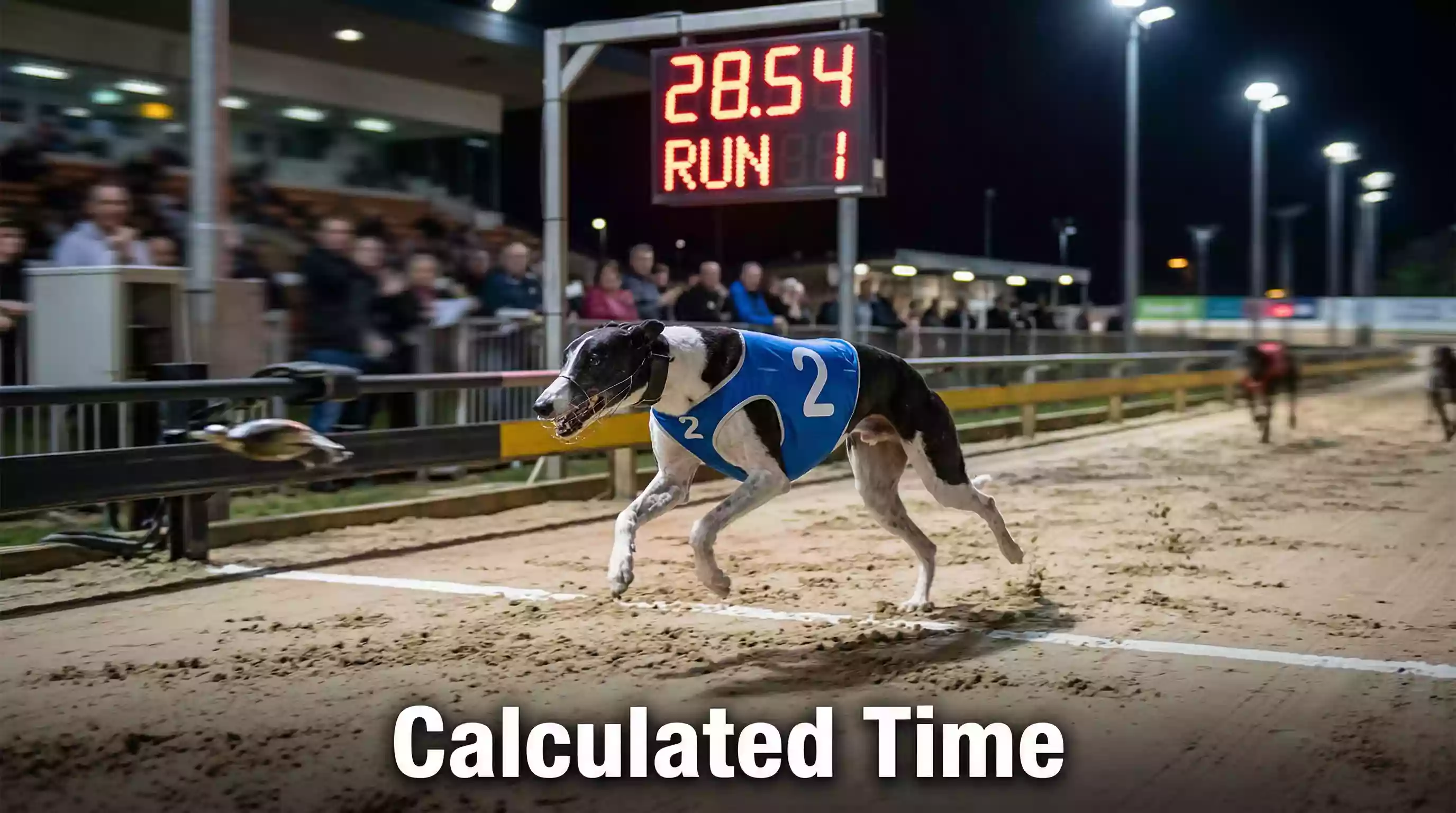
Calculated time strips away the variables that make raw finishing times unreliable. Track conditions change from meeting to meeting. A dog that encounters trouble in running loses time through no fault of its own. The clock does not distinguish between a dog that ran a clear race on fast going and one that was bumped at the second bend on a heavy surface — but calculated time does. It is the single most useful metric in greyhound form analysis, and understanding how it works is the difference between comparing like with like and comparing apples with weather reports.
CT appears on most detailed result sheets and form databases in the UK. It is the number that serious form students use to rank dogs, assess grade changes and identify value. The raw finishing time has its place — it tells you what the clock recorded — but CT tells you what the dog was actually capable of on the day.
How CT Is Derived
The formula is straightforward in principle. Calculated time equals actual finishing time, adjusted for going allowance and — where applicable — a trouble allowance. Each adjustment shifts the raw time toward a standardised figure that represents what the dog would have run on a perfect surface with a clear passage.
The going allowance is the larger of the two adjustments. It corrects for the condition of the track surface at the time of the race. Standard going — dry, firm, well-maintained sand — is the baseline at zero. If the going is assessed as slow (positive allowance), the adjustment subtracts time from the raw figure, because the dog was running on a surface that made it slower. If the going is fast (negative allowance), time is added, because the surface flattered the performance. The going is assessed by the racing manager before each meeting and applied to every race on the card.
The trouble allowance is smaller and more subjective. When a dog encounters interference — crowding, bumping, checking — the in-running commentator may assign a time credit to account for the lost ground. This credit is added to the adjusted time to produce the final CT. The allowance varies depending on the severity of the trouble and the point in the race where it occurred. A bump at the first bend on a 450-metre race loses more time than a check on the run-in, and the allowance reflects that.
Not all result sources publish trouble-adjusted CT. Some platforms — particularly the free aggregators — show only the going-adjusted figure. The full CT, including trouble allowance, is most reliably found on premium form services like Timeform, which employ specialists to assess each race and assign allowances.
The 640-metre track record at Sunderland — 38.79 seconds, set by New Destiny in the 2025 ARC Grand Prix — is recorded as an actual time. Whether the CT for that run differs from the raw figure depends on the going assessment for that meeting and whether New Destiny encountered any trouble. On near-standard going with a clear run, the CT and the actual time converge — which is what makes that record particularly authoritative.
CT vs Actual Time — When They Diverge
On a standard-going night with clean racing, CT and actual time are identical. These are the easy cases — the numbers match, and no adjustment is needed. The complications arise when conditions deviate from the norm, which is most meetings.
Heavy going is the most common cause of divergence. A dog that posts an actual time of 29.10 over 450 metres on a going of +30 (thirty hundredths slow) produces a CT of 28.80. The actual time looks pedestrian; the CT reveals a genuinely quick performance hidden behind a sluggish surface. Without the going adjustment, this dog would be dismissed by anyone scanning raw times — and that is exactly the kind of mispricing that CT is designed to prevent.
Fast going works in reverse. An actual time of 28.00 on a going of -15 gives a CT of 28.15. The dog was quick, but the surface helped. The CT tempers the impression and places the performance in its proper context. Dogs that post eye-catching raw times on fast going are sometimes overrated in the grading system, because the racing manager may use the actual time for grade assessment while form students use the CT. The two figures can tell different stories.
Trouble in running creates the most dramatic gaps. A dog that is badly crowded at the second bend, loses four lengths, and finishes in 29.30 might receive a trouble allowance of 0.40 seconds, producing a CT of 28.90. That is a completely different performance from the one the actual time suggests. The trouble-adjusted CT says the dog was capable of running at a level well above what it appeared to achieve — and if the trouble was a one-off (rather than a pattern), the next clean run could produce a finishing time much closer to the CT.
At Sunderland, the interaction between going and the track’s technical characteristics adds another layer. The 93-metre run-up on the 450-metre distance and the 84-metre run-up on the 640-metre distance mean that dogs hit the first bend at high speed, and any going variation affects the approach phase differently from the bends and the straight. The single going allowance applied to the entire race is an approximation — useful, but not perfect.
See also Sunderland Greyhound Stadium Capacity, Facilities; Venue Layout
Using CT for Dog Comparison
The most practical use of CT is comparing dogs entered in the same race. Pull up the racecard, find each dog’s best recent CT over the race distance, and rank them. The dog with the lowest CT is the one that has demonstrated the most ability in adjusted terms. It is not a guaranteed winner — trap draws, pace dynamics and the unknowable variable of the day all intervene — but it is the most defensible starting point for analysis.
Comparing CT across different tracks requires more caution. Sunderland’s 379-metre circumference, Outside McGee hare and specific sand surface create a running environment that differs from, say, Romford’s tighter circuit or Towcester’s wider layout. A CT of 28.30 at Sunderland does not mean exactly the same as 28.30 at another venue. The figures are broadly comparable, because the going adjustment normalises surface conditions, but track geometry and running dynamics introduce variations that the CT formula does not capture.
GBGB’s expanded programme of STRI track inspections — now quarterly rather than biannual — helps improve the consistency of track surfaces across the licensed network, which in turn makes CT comparisons more reliable than they were a decade ago. Better surfaces, more rigorously maintained, mean the going assessment is applied to a more uniform baseline. The system is not perfect, but it is improving.
For anyone building a form-study routine around Sunderland results, CT should be the primary time metric. Record it alongside the grade, the trap, the in-running comments and the going figure for each run. Over a period of weeks, the CT data builds into a picture of each dog’s true ability that is far more reliable than the raw times alone. It is the closest thing greyhound racing has to an objective performance measure — and in a sport where subjectivity creeps into almost every other variable, that objectivity is worth guarding. Calculated Time in Greyhound Racing — More on this topic at sunderland greyhound results.
