Greyhound Racing Centenary — A Hundred Years of UK Dog Racing
Best Horse Racing Betting Sites – Bet on Horse Racing in 2026
 Available in US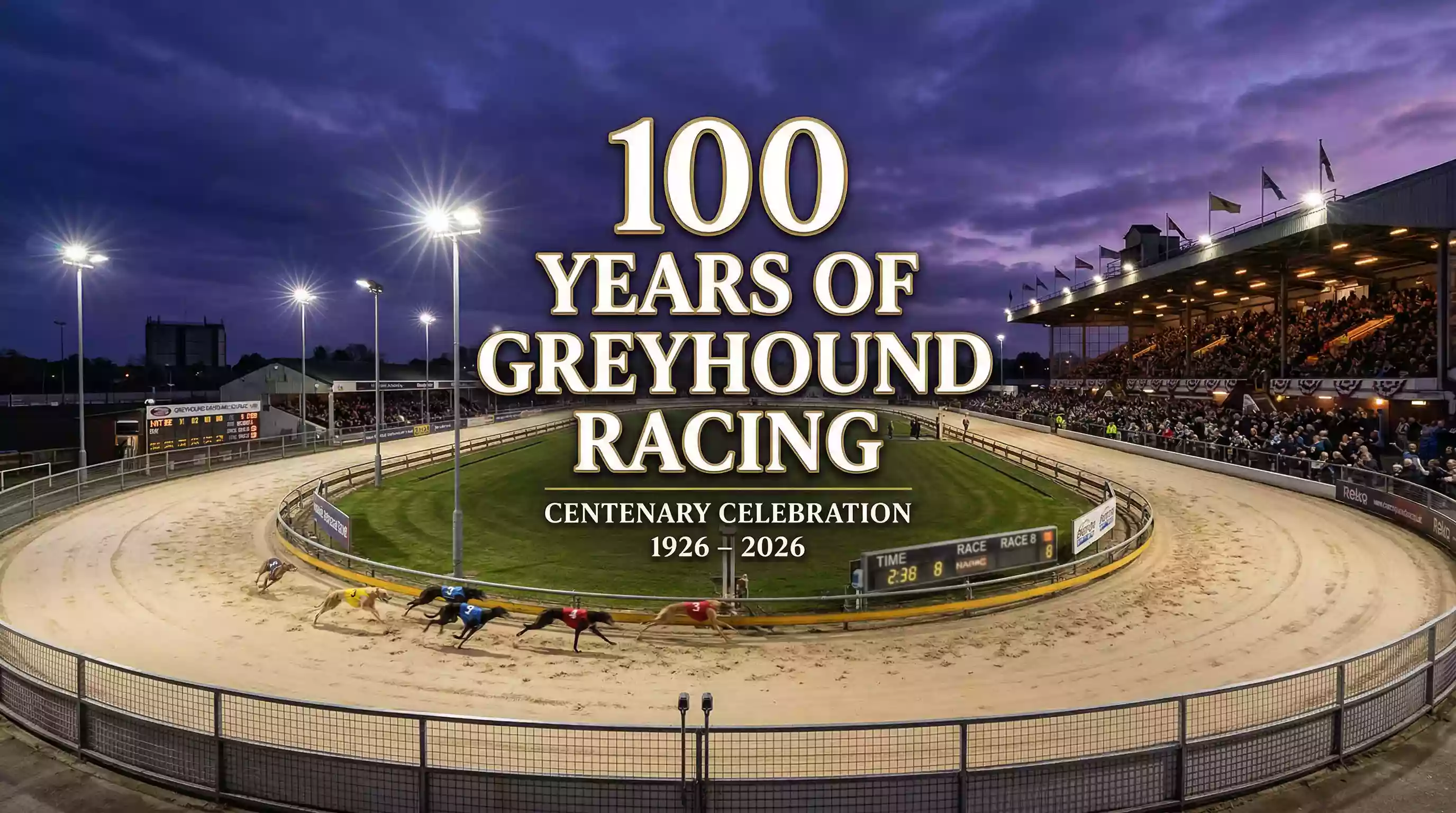
On 24 July 2026 it will be exactly one hundred years since a greyhound named Mistley chased a mechanical hare around Belle Vue stadium in Manchester, crossing the line in 25.00 seconds over 440 yards in front of 1,700 spectators. That was the first organised greyhound race in Britain. What followed was one of the most dramatic sporting trajectories in the country’s history — an explosion of popularity, a golden age of mass attendance, and then a long, grinding decline that has left the sport with eighteen licensed tracks, a fraction of its former audience, and a centenary that feels as much like a reckoning as a celebration.
The greyhound racing centenary in 2026 marks a sport that peaked, contracted and is now fighting to justify its place in a leisure market that has moved on. Understanding what happened across those hundred years puts the present — and Sunderland’s role in it — in the context it deserves.
The First Race and the Boom
The 1926 Belle Vue meeting was an experiment. An American promoter, Charles Munn, had seen oval-track greyhound racing succeed in the United States and believed the concept could be adapted for British audiences. The mechanical hare — replacing the live hare used in traditional coursing — was the key innovation. It made the sport controllable, repeatable and suitable for an enclosed stadium where admission could be charged and bets could be placed under regulated conditions.
The experiment worked beyond anyone’s reasonable expectations. Within a year of the Belle Vue opening, attendance at greyhound meetings across the country reached 5.5 million. By 1928, that figure had surged to 13.7 million. In 1929, it hit 16 million. The growth was so rapid that new tracks were being built as fast as promoters could find sites and financing. By the end of the 1930s, Britain had 77 licensed greyhound stadiums and more than 200 independent venues — 33 of them in London alone.
The appeal was a cocktail of accessibility and excitement. Greyhound racing was cheap to attend, easy to understand, and fast enough to hold the attention of working-class audiences who had limited leisure time and limited budgets. The betting was central — this was a sport built around wagering from day one — and the evening schedule meant it did not compete with daytime factory shifts or Saturday afternoon football. It filled a gap in the leisure calendar that nobody had known existed.
The post-war years extended the boom. Returning servicemen looking for entertainment and the gradual relaxation of wartime austerity measures pushed attendance figures to levels that made greyhound racing one of the most-attended spectator events in Britain. This was the era when Sunderland opened — 23 March 1940, at a cost of £60,000 — entering a sport that was, at that moment, still growing.
Stars emerged. Mick The Miller, the first greyhound to become a genuine public celebrity, won the English Greyhound Derby in 1929 and 1930 and appeared in a feature film. His fame crossed the boundary between sport and popular culture in a way that no greyhound has managed since. Later decades produced their own legends — Ballyregan Bob, Scurlogue Champ, Westmead Hawk — but Mick The Miller defined the era when greyhound racing was unmistakably mainstream.
The Decline — Closures and Competition
The decline started in the 1960s and has never really stopped. Television pulled audiences away from live events across all sports, but greyhound racing was hit harder than most because its core audience — working-class punters — was also the demographic most rapidly adopting television as a primary entertainment source. The legalisation of betting shops in 1961 was the second blow: punters could now bet on greyhound racing without being at the track, which removed one of the main reasons for attending in person.
Tracks began to close. Between 1960 and 2010, 91 NGRC-licensed greyhound stadiums shut their doors permanently. Some were demolished for housing, some for retail development, some simply fell into disrepair as owners lost the will or the finances to maintain them. London, which had hosted 33 venues at the peak, saw track after track disappear — Wembley, White City, Wimbledon, Catford, Hackney — until the capital’s circuit was reduced to a handful of survivors.
The closures accelerated in the 2000s and 2010s as property values in urban areas made the land beneath greyhound stadiums more valuable than the stadiums themselves. Wimbledon, one of the most famous names in UK greyhound racing, closed in 2017 to make way for a new football stadium. Each closure removed not just a venue but a community — the trainers, staff, regulars and dogs that depended on it.
By 2025, the licensed track count stood at eighteen. Scotland lost its last track that year. Wales is scheduled to ban the sport entirely between 2027 and 2030. The trajectory is unmistakable. A century that began with explosive growth is ending with a sport clinging to a fraction of its former footprint.
See also Responsible Gambling at Greyhound Racing.
The Centenary Year — What GBGB Has Planned
GBGB has launched 100 Years on Track as its centenary campaign for 2026. The programme is part celebration, part advocacy — a conscious effort to remind the public, politicians and the media that greyhound racing has a history worth acknowledging and a future worth protecting.
Mark Bird, GBGB’s Chief Executive, has framed the centenary as a moment to honour the sport’s heritage while making the case for its continued relevance. He has spoken of remembering the great dogs and the great moments — Mick The Miller, Ballyregan Bob, Scurlogue Champ, Westmead Hawk — while also demonstrating that greyhound racing has earned its place in the modern era through welfare reform, regulatory improvement and commercial adaptation.
Sunderland occupies a meaningful position in the centenary narrative. As a track that opened in 1940 — just fourteen years after the first race at Belle Vue — it is one of the oldest continuously operating greyhound stadiums in Britain. It has survived wartime, the television revolution, the betting-shop shift, the property boom and the corporate consolidation of the ARC era. Its continued operation is itself an argument for the sport’s resilience, and GBGB’s centenary programme is expected to highlight surviving tracks like Sunderland as evidence that the sport’s foundations are still solid where investment and management have been sustained.
The centenary date — 24 July 2026 — falls on a Friday, which at Sunderland would be an open-racing night. Whether the track stages a specific centenary event on that date is a matter for ARC’s events calendar, but the alignment is there: a hundred years to the day since Mistley ran at Belle Vue, with the traps opening at one of the sport’s oldest surviving venues for a Friday night card that connects directly to that original moment.
A hundred years is a long time for any sport. That greyhound racing reaches the milestone in diminished circumstances does not erase what it built or what it meant to millions of people across a century of British life. The centenary is an honest occasion — a mix of pride and realism — and the eighteen tracks still racing in 2026 are, for better or worse, the carriers of that legacy. Greyhound Racing Centenary — More on this topic at sunderland greyhound results.
