How to Read a Greyhound Racecard — Every UK Abbreviation and Form Figure Explained
Best Horse Racing Betting Sites – Bet on Horse Racing in 2026
 Available in US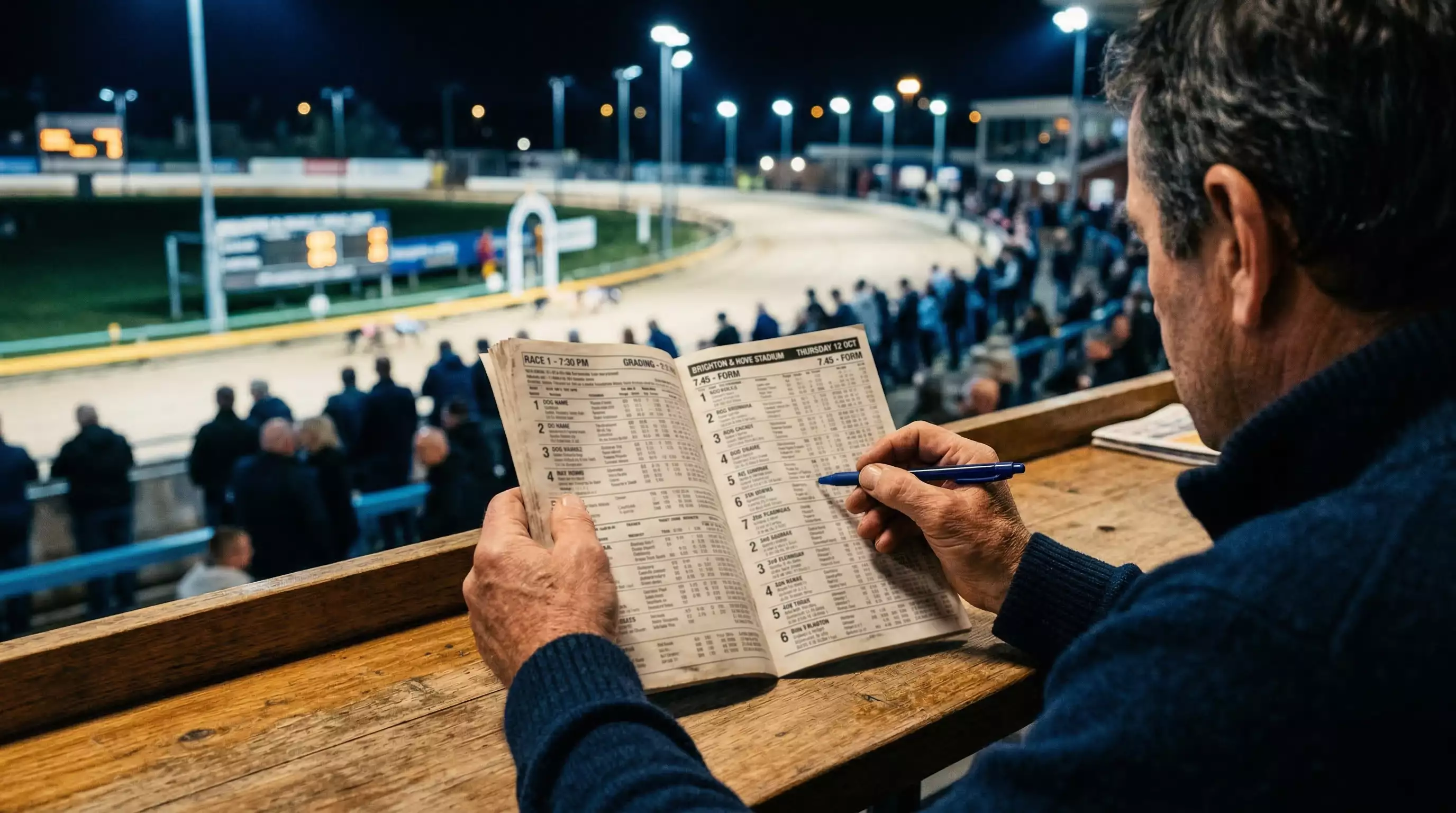
A greyhound racecard packs more than fifteen data points per dog into a grid that fits on a phone screen. Trap colour, dog name, trainer, weight, best recent time, form figures, in-running comments from previous races, grade, and starting price — all compressed into a format that assumes you already know the code. If you do not, the racecard is just a wall of numbers and letters. If you do, it is a compressed race biography that tells you nearly everything you need to make an informed judgement before the traps open.
Reading a greyhound racecard is the single most useful skill a UK racegoer or bettor can develop. It is the difference between picking a dog because you like its name and picking a dog because its last six runs show consistent early pace from Trap 2 on a going that matches tonight’s conditions. Both approaches will produce winners on any given evening — greyhound racing is unpredictable enough to reward random selection occasionally — but only one of them compounds into better decisions over time.
This guide walks through every element of a standard UK greyhound racecard as you would encounter it at Sunderland Greyhound Stadium or on any of the major results platforms. We start with the layout — what sits where and why — then decode the in-running abbreviations that commentators and race analysts use, explain the form figures and what they reveal about a dog’s recent history, cover going allowance and calculated time so you can compare dogs fairly across different meetings, and finish with a practical walkthrough of a hypothetical race at Sunderland that ties everything together. By the end, you will be reading a greyhound racecard the way it was designed to be read.
Anatomy of a UK Greyhound Racecard
Open any greyhound racecard — paper or digital — and you will see the same fundamental structure. Six rows, one per dog, each row identified by a trap number and a colour. The trap numbers run from 1 to 6 and correspond to the starting boxes on the track. The colours are standardised across all GBGB-licensed venues in the UK: Trap 1 is red, Trap 2 is blue, Trap 3 is white, Trap 4 is black, Trap 5 is orange, and Trap 6 is black-and-white striped. The dogs wear jackets matching their trap colour, so even from the other side of the stadium you can tell which dog is which during a race.
Each row contains the following information, typically reading left to right. The trap number and colour anchor the row. Next comes the dog’s name, which is registered with the GBGB and unique to that greyhound. Below or beside the name you will usually find the trainer’s name — the licensed professional responsible for the dog’s conditioning, racing schedule and welfare. At Sunderland, the regular trainers are familiar names to local racegoers, and trainer form can be a factor in your analysis: some trainers specialise in certain distances or grades.
The form figures are the string of numbers and letters that appear after the dog’s name. These summarise the dog’s most recent race results and we will unpack them fully in a later section. For now, know that the form figures are the single most information-dense element on the card — they tell you where the dog finished, from which trap, at which grade, and sometimes at which track.
Next comes the best recent time, recorded in seconds and hundredths. This is usually the best time the dog has posted over the distance being raced in recent outings. At Sunderland, where the 379-metre circumference track hosts races over four distances — 261, 450, 640 and 828 metres — the best time should be compared only against other dogs’ times over the same distance. The run-up to the first bend is 93 metres on the 450-metre trip and 84 metres on the 640, and those differences influence the times dogs produce at each distance. Comparing a 450-metre time against a 640-metre time is meaningless, but you would be surprised how often novice racegoers make exactly that mistake.
The weight is recorded in kilograms and reflects the dog’s weigh-in on race day. Greyhounds typically race at between 26 and 36 kg, depending on the individual. Small fluctuations of half a kilo between races are normal and rarely significant. Larger changes — a kilo or more since the last outing — may indicate a change in condition worth noting, particularly if the dog has gained weight after a spell out of racing.
The grade identifies the class of the race. GBGB-licensed tracks use a system that runs from A1 at the top through to D4 and below at the lower end, with open races sitting outside the grading ladder entirely. The grade matters because it determines the quality of opposition: a dog winning comfortably in D2 may struggle when promoted to C1, even if its times look comparable, because the competition is sharper and the margins tighter.
Finally, the starting price or forecast odds appear on digital racecards and are updated as close to race time as possible. On paper racecards distributed at the stadium, odds may be absent or listed as a morning forecast. The starting price reflects the betting market’s collective assessment of each dog’s chances — which is useful as a starting point but not as a substitute for your own analysis. The market gets it right about 35% of the time for favourites across UK greyhound racing, which means it gets it wrong roughly twice as often as it gets it right.
Some racecards include additional data columns: in-running comments from previous races, sectional times (where available), calculated time and going allowance. We will cover each of these in the sections that follow.
Abbreviations Decoded — The Full In-Running List
The in-running comments on a greyhound racecard are the race analyst’s shorthand for what happened during a previous run. They appear as strings of abbreviations — SAw, EPace, Crd, Bmp1, Ld2 — and if you can read them, they tell you the story of a race in compressed form. The abbreviations are standardised across all GBGB-licensed tracks, which means the shorthand you learn at Sunderland works identically at Nottingham, Romford or any other UK venue. This section covers the most common in-running abbreviations, organised by the phase of the race they describe.
At the Start
SAw — Slow away. The dog was slow to leave the trap when the lids opened. This is one of the most important abbreviations on the card because a slow start in greyhound racing is often unrecoverable, particularly over shorter distances. A dog that shows SAw in multiple recent runs may have a trapping problem — a behavioural or physical issue that causes it to hesitate at the start. Conversely, a dog with no SAw entries is confirming that it breaks cleanly and consistently.
QAw — Quick away. The opposite of SAw. The dog broke sharply from the trap and gained an early positional advantage. A string of QAw entries suggests a dog with a reliable early-pace profile, which is particularly valuable over sprint distances.
VQAw — Very quick away. An emphatic version of QAw, indicating a lightning start. Dogs with VQAw entries are likely to lead into the first bend if drawn in a favourable trap.
Early Running
EPace — Early pace. The dog showed speed in the first section of the race, typically from the start through to the first or second bend. EPace entries identify front-runners — dogs that want to lead from the off. This is different from QAw, which refers specifically to the trap start: a dog can be slow away but still show early pace if it accelerates quickly after leaving the boxes.
MsPace — Mid-show pace. The dog showed pace in the middle section of the race, typically between the second and fourth bends. MsPace dogs are often stalkers — they sit behind the early leaders and make their move through the middle of the race.
Ld1, Ld2, Ld3 — Led at bend 1, 2, 3. The dog was in the lead at the specified bend. This is useful for understanding when a dog typically takes the lead — an Ld1 dog is an early leader, while an Ld3 dog is one that comes from behind. At Sunderland, where the 450-metre trip involves four bends, the Ld notations tell you the dog’s preferred part of the race.
Mid-Race Incidents
Bmp — Bumped. The dog made contact with another runner during the race. Bmp is often followed by a bend number: Bmp1 means the dog was bumped at the first bend, Bmp3 means the third bend. Bumping is the most common form of interference in greyhound racing and can range from a minor brush that has no effect on the result to a heavy collision that knocks a dog off its stride completely. A single Bmp entry is unremarkable; repeated Bmp entries in the same position (say, Bmp1 in three consecutive runs) may indicate that the dog is running a line that consistently brings it into conflict at that point on the track.
CkBmp — Checked and bumped. More severe than Bmp: the dog was checked (slowed) as a result of the contact. A CkBmp entry suggests that the dog’s finishing position was materially affected by the incident, which makes the run less reliable as a guide to the dog’s true ability over the distance.
Crd — Crowded. The dog was hemmed in by other runners and lost ground or momentum. Crowding typically happens at bends, where the field compresses and dogs on the inside or middle of the track can find themselves boxed in with nowhere to go.
Wide — Ran wide. The dog lost ground by running wide on one or more bends, covering more distance than the dogs on the inside. Wide running is not always a problem — some dogs run their fastest races from a wide position — but it is a ground-losing move that requires extra speed to compensate.
RIs — Ran on inside. The dog held a position on the rail. This is often a positive comment, indicating that the dog ran an economical race by hugging the shortest route around the track.
Finish
RnIn — Ran in. The dog finished strongly, closing on the leaders through the home straight. An RnIn comment suggests late pace and stamina — qualities that become more valuable over longer distances like the 640 and 828 at Sunderland.
RnOn — Ran on. Similar to RnIn but with a slightly different emphasis: the dog maintained its pace to the line without necessarily closing dramatically on the leaders. An RnOn entry indicates honest effort and consistent finishing.
Fin — Finished. Followed by a position number: Fin2 means finished second, Fin3 means third. This confirms where the dog finished in the final standings. Combined with the earlier Ld and Bmp entries, the Fin notation tells you whether the dog held its position, improved through the race, or faded.
Reading in-running comments is a skill that develops quickly with practice. After a few racecards, the abbreviations stop being code and start being a movie you can replay in your head: the dog broke fast (QAw), led into the first bend (Ld1), got bumped at the third (Bmp3), but ran on to finish second (RnOn, Fin2). That story, compressed into a dozen characters, tells you almost everything you need to know about how the dog ran.
Form Figures — What the Numbers and Letters Tell You
The form figures on a greyhound racecard are the dog’s recent race history compressed into a single line. They are read right to left — the most recent run is on the right — and each character or pair of characters represents one race. A typical form line might look like this: 3456 2111. Reading from the right, that dog has won its last three races (1, 1, 1), finished second before that (2), then had a sequence of declining finishes (6, 5, 4, 3). The trajectory is clear: a dog that was struggling, found form, and has been winning consistently.
Most racecards show the last six to eight runs, though some platforms display a longer history. The numbers represent finishing positions: 1 is first, 2 is second, through to 6 in a standard six-dog field. A letter F in the form figures indicates a fall — the dog went down during the race. A T indicates the run was a trial rather than a competitive race. An O usually means the run was at an open race — a higher-level fixture that sits outside the normal grading ladder.
Some racecards include the trap number alongside each finishing position, which adds another layer of information. If a dog has finished 1-1-1 but all three wins came from Trap 1, and tonight it is drawn in Trap 5, you need to consider whether the change of draw will affect its chances. Trap-position context within form figures is particularly important at Sunderland, where the four race distances create different trap profiles.
The grade in which each run took place is sometimes shown alongside the form figures or in a separate column. A dog winning in D3 is not the same as a dog winning in B1, even if the finishing positions look identical. The grading system ensures that dogs are racing against broadly similar opposition, but promotion after a sequence of wins means a dog may be about to face significantly better rivals. Reading the form without checking the grade context is like judging a footballer by their goals without knowing whether they scored in the Premier League or League Two.
The national favourite win rate of 35.67% across all graded UK races in 2024 provides useful context for form analysis. If the betting market — which largely bases its prices on form — is correct only about a third of the time, then form figures alone are clearly not a reliable predictor of individual race outcomes. What they do is narrow the field: a dog with strong recent form is more likely to be competitive, but “more likely” is a long way from “certain.” The gap between those two concepts is where careful reading of the racecard separates informed bettors from hopeful ones.
As GBGB Executive Veterinarian Tiffany Blackett has noted, the ongoing CPD programme for licence holders is helping to ensure that the data flowing into racecards — from injury reporting to form recording — is “consistently implemented by all those working within the sport.” Standardised reporting matters because the form figures are only as reliable as the data behind them. If one track records in-running comments differently from another, or if weight and time data is entered inconsistently, the racecard becomes a less reliable tool. The push towards uniform standards across all GBGB venues means that when you read a form line at Sunderland, you can compare it meaningfully against form from Nottingham, Romford or any other licensed track.
Going Allowance and Calculated Time
If you have ever looked at two dogs’ best times and wondered why the one with the “slower” time is a shorter price, the answer is usually going allowance. The going at a greyhound track — the condition of the racing surface — changes with the weather, and those changes affect finishing times. A dog that runs 28.50 seconds over 450 metres on a fast surface has not necessarily run faster than a dog that records 28.80 on a slow surface. To compare them fairly, you need to adjust for conditions. That adjustment is the going allowance.
The going at UK greyhound tracks is measured before every meeting by the track’s official going reporter. The going is expressed as a number, usually ranging from about -20 (a very fast surface) through zero (standard) to +40 or more (a very slow surface). A negative going figure means the track is running fast — the surface is dry, firm and conducive to quick times. A positive figure means the track is running slow — typically because of rain, moisture or a freshly sanded surface.
The going allowance is the number of hundredths of a second per unit of going that is added to or subtracted from a dog’s raw finishing time to produce a standardised time. At most UK tracks, the allowance is approximately 0.01 seconds per going point per 100 metres of race distance, though the exact calculation varies by track and is set by the racing office. The formula sounds complicated, but in practice it means: if the going tonight at Sunderland is +10 (slow) and a dog runs 28.90 over 450 metres, the going allowance might adjust that time to something like 28.45 on a standard surface. Conversely, if the going is -10 (fast), a raw time of 28.10 might be adjusted upward.
This is where calculated time — often abbreviated as CT on racecards — comes in. Calculated time is the dog’s raw finishing time adjusted for the going on the day it ran. It is the closest thing greyhound racing has to a standardised performance metric, because it strips out the track conditions and gives you a number that can be compared across different meetings, different days and different weather. When you see a CT figure on a racecard, that is what you should be comparing — not the raw times.
At Sunderland, where five meetings a week means the going can vary significantly between a dry Monday BAGS meeting and a rain-soaked Friday night, calculated time is especially important. A dog that posted a raw time three lengths faster than its rivals on Monday may have been running on a going of -15, while the Friday meeting might be +5. Without the CT adjustment, you would be comparing apples to oranges. With it, you have a common currency.
One practical tip for reading a greyhound racecard at Sunderland: always check the going report for the current meeting before comparing dogs’ historical times. The going is usually announced before the first race and can be found on the stadium’s website or through the major results platforms. If tonight’s going is significantly different from the going on the days when the dogs in a particular race last ran, the CT figures will do the heavy lifting for you — but you need to know the current conditions to contextualise what you are seeing.
A common error is to over-rely on calculated time without considering other factors. A dog with the best CT in a race may still lose if it breaks slowly, gets bumped at the first bend, or is drawn in a trap that does not suit its running style. CT is one input, not the answer. Use it alongside form figures, in-running comments, trap draw, and your understanding of the dog’s pace style to build a complete picture. No single number on the racecard tells the whole story, and reading a greyhound racecard well means synthesising all of them.
See also Sunderland Greyhound Distances and Track Records.
Putting It All Together — Walking Through a Real Racecard
Theory is useful, but racecards are read in practice. Let us walk through a hypothetical 450-metre graded race at Sunderland and apply everything we have covered. The race is a C3 on a Friday evening, the going is reported at +5 (slightly slow), and the six dogs are drawn as follows.
Trap 1 (Red) — Ballymac Jet. Form: 111232. Trainer: a local handler with a strong Sunderland record. Best CT over 450m: 28.15. In-running from last race: QAw, Ld1, Ld2, Ld3, RnOn. Weight: 31.2 kg (unchanged from last run). This dog has won three of its last six, always from inside draws, and the in-running tells you it leads from the front. Drawn in Trap 1 tonight — its preferred position — with early pace confirmed. This is a dog that wants to lead from the lids and hold on.
Trap 2 (Blue) — Droopys Sonic. Form: 434521. Trainer: a visiting trainer from the Midlands. Best CT over 450m: 28.22. In-running from last race: SAw, Bmp1, MsPace, RnIn. Weight: 33.0 kg (+0.8 kg from last run). The most recent win (the 1 on the far right) is encouraging, but the form before that is inconsistent — fifth, second, fourth. The SAw in the last run is a concern: if this dog is slow away from Trap 2, it risks getting crowded by Trap 1’s early pace. The weight gain is not dramatic but worth monitoring.
Trap 3 (White) — Knockrobin Holly. Form: 666543. Trainer: a Sunderland regular. Best CT over 450m: 28.35. In-running from last race: EPace, Crd2, Wide3, Fin3. Weight: 27.8 kg. The form is improving from left to right (6-6-6 to 5-4-3), which is a positive trajectory, and the in-running suggests a dog that shows early pace but loses ground at the bends. The crowding at bend 2 and running wide at bend 3 in the last race suggest this dog might benefit from a wider draw where it has room to manoeuvre. Drawn in Trap 3 tonight, it is squeezed between two dogs — the middle draw is not ideal for a dog that has been drifting wide.
Trap 4 (Black) — Swift Milo. Form: 222211. Trainer: a handler with five runners at the meeting. Best CT over 450m: 28.08. In-running from last race: EPace, Ld2, Ld3, Ld4, RnOn. Weight: 30.5 kg. This is the dog with the best calculated time in the race and two consecutive wins. The in-running shows a dog that leads from the second bend onwards — not a box-to-line leader like Trap 1, but a dog that gets to the front through pace rather than position. The concern is the draw: Trap 4 is a middle box, and this dog will need to work across the field to find its racing line.
Trap 5 (Orange) — Fabulous Lola. Form: 333332. Trainer: a trainer running two dogs at the meeting. Best CT over 450m: 28.25. In-running from last race: MsPace, Bmp2, RnIn, Fin2. Weight: 26.1 kg. A consistent dog — five thirds and a second in the last six runs — that finishes strongly but never quite gets there first. The MsPace and RnIn profile tells you this is a closer, not a leader. If the early pace dogs tire or interfere with each other, this dog has the finishing speed to pick up the pieces. Trap 5 at Sunderland is not a bad draw for a midfield-to-closer running style, and the Outside McGee hare gives this dog a reasonable line towards the lure.
Trap 6 (Striped) — Ravenswood Bolt. Form: 145164. Trainer: a Newcastle-based handler. Best CT over 450m: 28.18. In-running from last race: SAw, Wide1, Wide2, Crd3, Fin4. Weight: 34.2 kg. The form is erratic — a win, a fourth, a fifth, a first, a sixth, a fourth — and the in-running from the last race is poor: slow away, ran wide on both early bends, got crowded, finished fourth. The best CT is competitive (28.18), but the inconsistency and the Trap 6 draw on a night when the inside traps contain confirmed front-runners make this a risky proposition.
So what would an informed reading of this racecard tell you? Trap 1 and Trap 4 are the two strongest contenders on form and CT. Trap 1 has the positional advantage — inside draw, confirmed early pace, the rail to protect its running line. Trap 4 has the superior time but a less favourable draw and needs to find space in the middle of the field. Trap 5 is the each-way play: consistent, strong-finishing, and drawn in a position where the Outside McGee hare helps. Traps 2, 3 and 6 all carry red flags — slow trapping, inconsistency, and draws that do not suit their running styles.
None of this guarantees a result. The favourite — likely to be Trap 4 on best time or Trap 1 on draw and early pace — wins roughly a third of UK graded greyhound races. But reading a greyhound racecard with this level of detail gives you an informed position from which to make a judgement, and that is immeasurably better than picking a name or a colour. For context, New Destiny broke the Sunderland 640-metre track record with 38.79 seconds in April 2025 — a performance that was predictable to anyone who had been reading her racecard form leading into the ARC Grand Prix. The data was there for anyone willing to read it. How to Read a Greyhound Racecard — More on this topic at sunderland greyhound results.
