BAGS Greyhound Racing Explained — What Afternoon Meetings Are and Why They Exist
Best Horse Racing Betting Sites – Bet on Horse Racing in 2026
 Available in US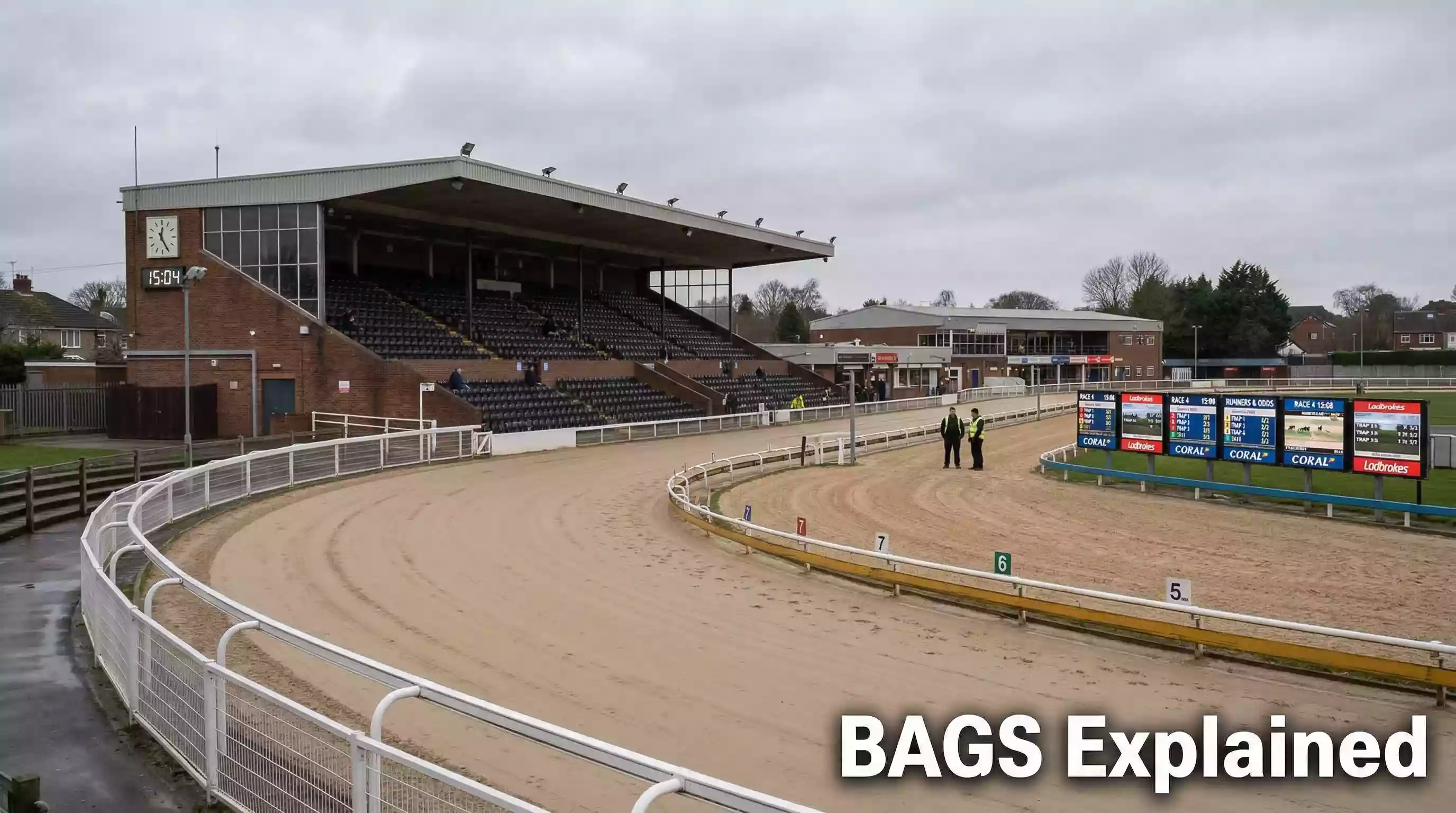
BAGS greyhound racing is the engine that keeps most UK greyhound stadiums financially viable. Without it, the majority of tracks — Sunderland included — would struggle to justify running five meetings a week. The acronym stands for Bookmakers Afternoon Greyhound Service, and the name tells you almost everything you need to know about its purpose: it exists to supply live racing content to betting shops during the hours when horse racing is unavailable or sparse.
Most of the daytime races run at Sunderland on any given week are BAGS races. Monday and Wednesday are BAGS afternoons, meaning those fixtures are staged not for the trackside crowd but for the cameras. The results from these meetings flow straight into the betting ecosystem — broadcast via satellite to licensed bookmakers and streamed online to punters following the action remotely.
Understanding how BAGS works is not just trivia. It changes the way you read Sunderland’s results, because the nature of a BAGS meeting — the field quality, the grading, the purpose behind each race — is different from what you see on an open-racing night.
Origins — The 1967 Consortium
BAGS was born in 1967, the creation of a consortium of bookmakers who needed a solution to a very specific problem: wet winter days. When frost, fog or waterlogged turf forced the cancellation of horse racing fixtures, betting shops had nothing to show their customers. Empty screens meant empty tills. Greyhound racing, which runs on sand regardless of weather, was the obvious fix.
The original BAGS tracks included Park Royal, Kings Heath, Stamford Bridge and Oxford — venues that could reliably stage afternoon meetings while the horse racing programme was wiped out. The concept was straightforward: bookmakers would fund the fixtures through a rights fee, the stadia would receive guaranteed income for staging the races, and the betting shops would have a product to sell when nothing else was running. It was a commercial arrangement with no pretence of sporting grandeur — purely transactional, and all the more effective for it.
What started as a wet-weather backup quickly became a permanent fixture. Bookmakers realised that afternoon greyhound racing generated steady turnover regardless of whether horse racing was on or not. By the 1970s and 1980s, BAGS meetings were a daily feature of the UK betting landscape, and greyhound stadia that secured BAGS contracts found themselves with a reliable income stream that supplemented — and in many cases exceeded — the revenue from their open-racing nights.
The timing of the 1967 launch mattered. Betting shops had only been legal since 1961, and the industry was still figuring out how to fill a full day’s trading with live content. Greyhound racing slotted into that gap perfectly — fast races, quick turnarounds, minimal weather disruption. The consortium model also set a precedent: bookmakers would collectively fund the content they needed, rather than relying on individual deals with individual tracks.
The model has survived every upheaval the betting industry has thrown at it: the shift from on-course to off-course betting, the deregulation of betting shops, the arrival of online gambling. Nearly six decades after it was invented, BAGS remains the commercial lifeline of licensed greyhound racing in Britain.
How BAGS Works Today
The scale of BAGS in 2026 is hard to overstate. The system accounts for approximately 28,000 greyhound races a year — more than half of all licensed greyhound racing in Britain. Across all BAGS-contracted tracks, around 74 meetings take place every week, involving roughly 5,772 individual greyhound runs. It is an industrial-scale operation, and it is what keeps the lights on at stadiums from Sunderland to Swindon.
The mechanics work through two media partners. SIS (Satellite Information Services) and TRP (The Racing Partnership) hold contracts with different groups of tracks to broadcast BAGS fixtures into bookmakers’ shops and online platforms. Arena Racing Company, which operates Sunderland, distributes much of its BAGS content through these channels. A five-year deal between ARC and GMG, which took effect in January 2025, covers 15 fixtures per week broadcast via TRP and Premier Greyhound Racing.
Each BAGS meeting follows a standard template: usually 12 races, run at intervals of roughly 15 minutes, with racecards published the previous evening. The races are graded — typically from C downward — and the fields are drawn from dogs registered at the hosting track or visiting from nearby stadia. Trainers receive appearance money and prize money funded by the BAGS contract, and the bookmakers receive a continuous feed of live racing content that translates directly into betting turnover.
The system is not without critics. Because BAGS exists to generate volume, the sheer number of races staged each week puts pressure on greyhound availability. Dogs race more frequently, trainers must manage larger kennels, and the racing calendar leaves little room for rest. The relationship between volume and welfare is a debate that runs through every level of the sport, from track management to the regulatory bodies that oversee it.
Still, the economics are unarguable. Without BAGS, most UK tracks would be reduced to one or two meetings a week — if they survived at all. The service was designed as a commercial solution, and nearly sixty years on it continues to fulfil that role with remarkable consistency.
See also Greyhound Grading System UK.
BAGS at Sunderland — What It Means for Results
At Sunderland, BAGS accounts for two of the regular weekly fixtures: Monday and Wednesday afternoons. Tuesday evenings and Sunday mornings add further meetings that round out the schedule. These are the meetings that produce the majority of the track’s results by volume, and they are the ones most punters encounter first — whether scrolling through an afternoon’s betting options or checking a results feed after work.
The key difference from open racing is grading. BAGS cards at Sunderland are dominated by C, D and E-grade races, with the occasional B-grade thrown in. The top-tier dogs — the A-graders and the open-class specialists — are reserved for Friday nights. So when you see a BAGS result from Sunderland showing a winning time of, say, 28.50 seconds over 450 metres, you are looking at a different calibre of field than you would see on a Friday night. The time itself is only meaningful in context.
Field composition shifts too. BAGS meetings see a higher turnover of visiting dogs from other tracks, because trainers with contracts at multiple stadia will rotate their animals through whichever BAGS fixture suits the schedule. A dog that ran at Newcastle on Monday might turn up at Sunderland on Wednesday. This cross-track movement makes BAGS form lines trickier to read — you need to account for different trap draws, different track geometries and different going conditions, all within the same week. BAGS Greyhound Racing Explained — More on this topic at sunderland greyhound results.
For the results-focused observer, BAGS data from Sunderland is still valuable. It provides a baseline for grading assessments, highlights dogs that are improving or declining through lower grades, and generates the volume of form lines needed for statistical analysis. The trick is to treat BAGS results as what they are — a different product from open racing — and to adjust your expectations accordingly. A dog that looks ordinary on a Wednesday afternoon BAGS card might be a different animal entirely when the Friday night crowd arrives and the grading moves up a notch. As Joe Scanlon, Chairman of the British Greyhound Racing Fund, has noted: the growing number of race meetings, driven by two content suppliers vying for bookmaker customers, means the impact on greyhound numbers is reaching a critical stage.
