Forecast and Tricast Betting in Greyhound Racing — How Payouts Work
Best Horse Racing Betting Sites – Bet on Horse Racing in 2026
 Available in US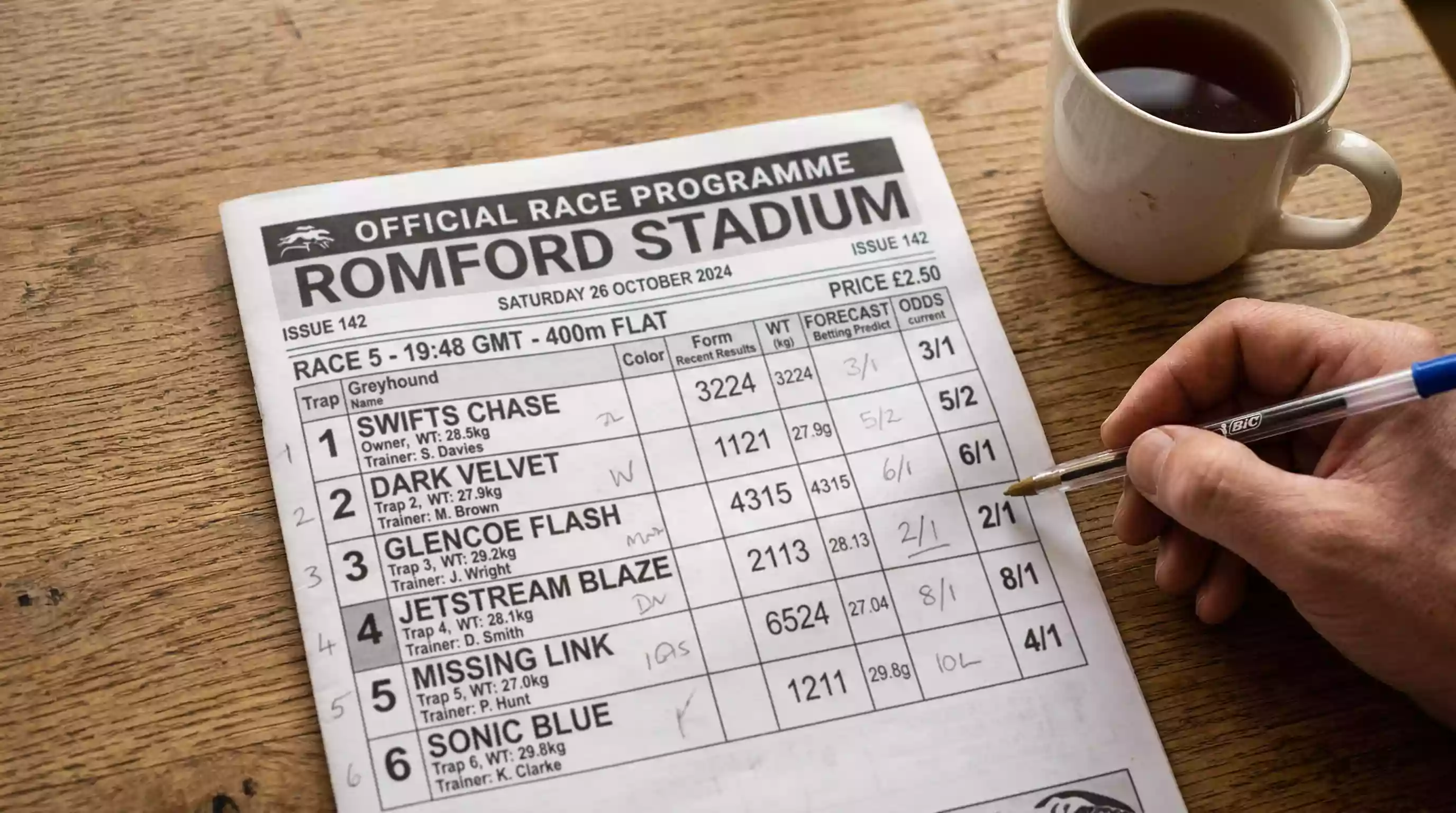
Forecast and tricast bets are printed on every greyhound result sheet in Britain. Scroll past the trap numbers, the finishing times and the SP odds, and you will find two additional lines: the forecast dividend and the tricast dividend. These are the payouts for the two most popular exotic bets in greyhound racing — the ones that ask you to predict not just the winner, but the exact finishing order of the first two or three dogs.
The appeal is obvious. A straight win bet on a short-priced favourite might return a few pounds. A forecast or tricast on the same race can return many times that, because predicting order is harder than predicting a single winner. In a six-dog field where any two or three results are plausible, the payouts can be substantial.
But the mechanics are not as simple as they first appear. There are multiple variations of each bet, the payout calculation is computer-generated rather than fixed, and understanding what the numbers on a result sheet actually mean requires a bit of unpacking.
Straight Forecast vs Reverse Forecast
A straight forecast is the simplest version. You pick the first and second finishers in the correct order. Get both right, and you are paid out at the computer straight forecast (CSF) price. Get the right two dogs but in the wrong order, and you lose. There is no margin for error — the sequence has to be exact.
The CSF is not a fixed odd that you can see before the race. It is calculated after the race by a formula that takes into account the starting prices of the two dogs and the overall betting market for the race. The principle is that a forecast involving two outsiders will pay significantly more than one involving the favourite and the second favourite, because the outcome was less likely according to the market. In practice, CSF dividends in greyhound racing range from a few pounds for predictable results to several hundred for upsets.
A reverse forecast relaxes the order requirement. You pick two dogs to finish first and second, and you are paid out regardless of which one wins and which finishes second. The cost is double a straight forecast — you are effectively placing two bets — and the payout is the CSF for whichever finishing order actually occurred. For races where you are confident about identifying the top two but less sure about which will lead, the reverse forecast is the natural choice.
Combination forecasts extend the concept further. You select three or more dogs and cover every possible first-and-second permutation. With three selections, that is six individual straight forecasts. With four, it is twelve. The cost rises quickly, but so does the coverage. Combination forecasts are popular in open-class races where the field quality is high and multiple dogs have a legitimate chance of filling the top two spots.
The scale of the UK greyhound betting market gives these bets their commercial weight. Bookmakers processed approximately £794 million in greyhound racing turnover through betting shops in the 2023–24 financial year, according to Gambling Commission data, and forecast bets account for a meaningful share of that total. They are built into the fabric of every meeting — trackside and off-course — and the dividends they produce are part of the standard result output for every race.
Tricast — Picking the Top Three
A tricast works on the same principle as a forecast but raises the difficulty — and the potential reward. You pick the first, second and third finishers in the exact order. With six dogs in a greyhound race, the number of possible first-second-third combinations is 120. Getting one right is genuinely hard, and the payouts reflect that.
The computer tricast (CT) dividend is calculated in the same way as the CSF: a post-race formula based on the starting prices of the three placed dogs and the structure of the overall market. Tricast dividends routinely run into three figures and can exceed a thousand pounds when the result involves multiple outsiders. Even in a short-priced race where the favourite wins, a tricast involving a long-shot third-place finisher can inflate the payout considerably.
A combination tricast — sometimes called a full-cover tricast — lets you select more dogs and covers every possible first-second-third permutation. Three selections means six individual tricast bets. Four selections means twenty-four. Five means sixty. The maths gets expensive fast, and most punters either stick to three carefully chosen dogs or use a banker — one dog they are confident will finish in the top three — and combine it with wider selections for the other two places.
Named tricasts also exist at some tracks, where a bookmaker will offer a fixed price on a specific tricast combination before the race. These are less common than the computer-calculated version and tend to appear only at meetings with significant on-course betting activity. At Sunderland, the computer tricast is the standard.
One thing worth noting: tricasts are only available on races with six or more runners. In a five-dog race — which can happen if a dog is withdrawn at the kennels — the tricast is voided and only the forecast is paid. This is printed on the result sheet, and it catches out the occasional punter who does not check the runner count before placing the bet.
See also Sunderland Greyhound Stadium Parking, Directions & How to Get There.
Reading Forecast and Tricast Returns in Results
On a standard UK greyhound result sheet — whether you are looking at the Sporting Life, the official Sunderland site, or a Racing Post results page — the forecast and tricast returns appear at the bottom of each race result. They are printed as a single figure: the payout to a £1 stake. So a forecast dividend of £14.30 means a £1 straight forecast on the correct first-and-second combination would have returned £14.30. A £2 bet would have returned £28.60, and so on.
The tricast dividend appears separately, usually on the next line. It is formatted the same way — a payout per £1 unit. A tricast dividend of £187.50 means the first three finishers, in the correct order, at a £1 stake, would have returned £187.50. Some result sheets print both the forecast and tricast dividends together; others separate them more clearly. The format varies slightly by source, but the information is the same.
There are two details that trip people up. First, the forecast dividend printed on a result sheet is always the straight forecast — the exact-order version. If you placed a reverse forecast, your payout is the straight forecast dividend for the actual finishing order, paid against a double-unit stake. Second, the dividends printed are always to a £1 unit. If you bet in different units, you multiply accordingly.
For anyone using results data to study form rather than to settle bets, the forecast and tricast dividends still carry useful information. A large forecast dividend tells you the result was unexpected — the market did not predict this finishing order, which might signal an improving dog, a favourable trap draw, or a race that was affected by trouble in running. A small dividend tells you the form book got it right. Over a run of meetings, tracking which types of races produce the biggest forecast upsets can highlight patterns in grading, trap bias or going conditions that are not immediately obvious from the times alone.
The total UK prize fund of approximately £15.7 million is sustained partly by the betting activity that forecast and tricast bets generate. These are not niche wagers — they are central to the economics of every meeting. The next time you scan a Sunderland result and notice a tricast paying £340, it is worth pausing to ask what the form data missed. The answer is often more instructive than the race itself. Forecast and Tricast Betting in Greyhound Racing — More on this topic at sunderland greyhound results.
