GBGB Licensed Greyhound Tracks UK — Full List, Distances & Key Facts
Best Horse Racing Betting Sites – Bet on Horse Racing in 2026
 Available in US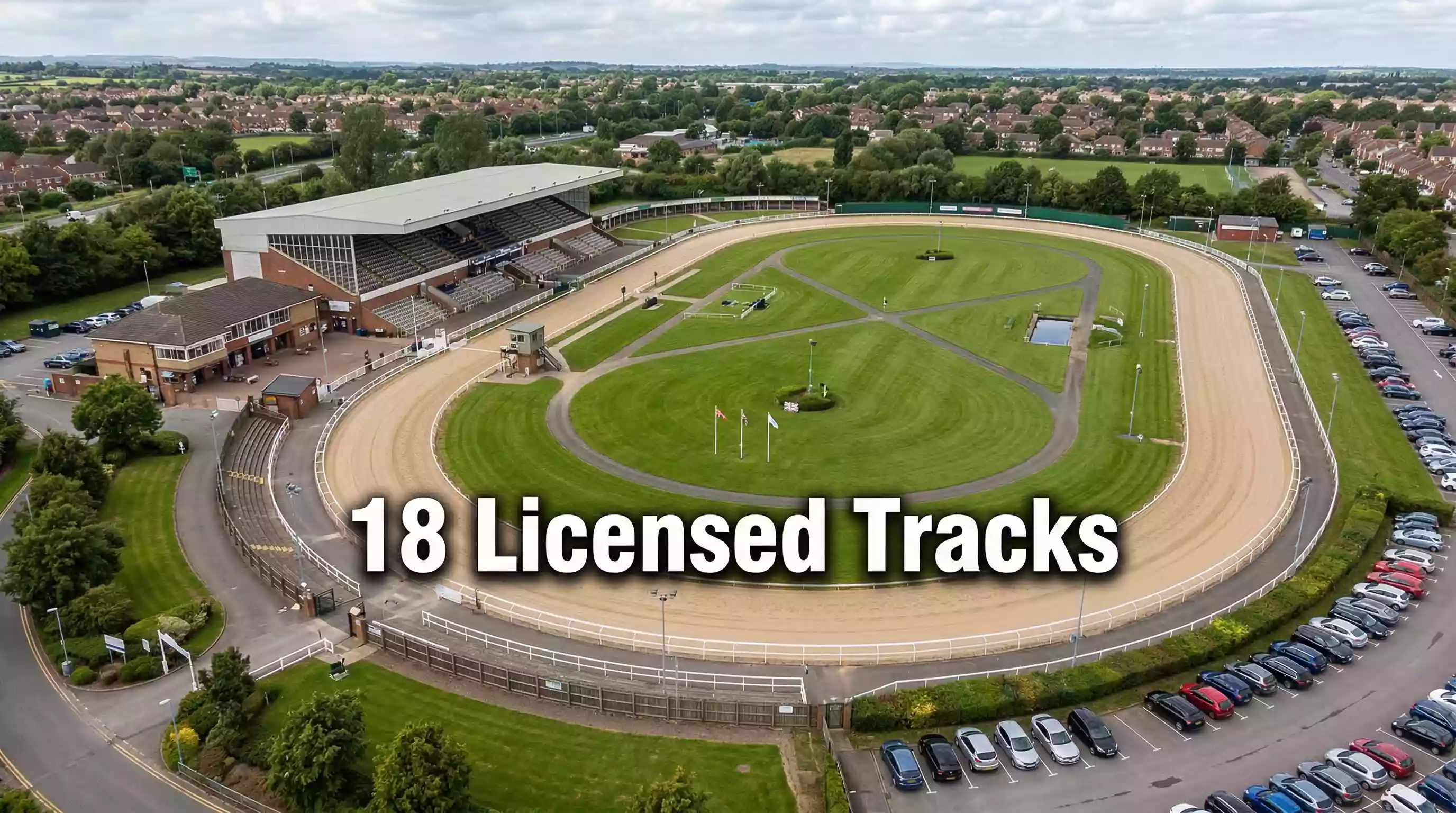
Eighteen GBGB-licensed greyhound stadiums remain in Great Britain as of 2025. That number would have seemed unthinkable in the 1940s, when 77 licensed tracks and over 200 independent venues kept the sport running across the country. The contraction has been relentless — decades of closures driven by television, betting-shop legislation, property values and changing public tastes have stripped the map back to its current skeleton. What survives is a network of professionally operated stadiums, most of them in England, each with its own distances, surface characteristics and hare type.
Sunderland is one of five stadiums operated by Arena Racing Company within this group. Understanding where it sits in the wider ecosystem — what it shares with other tracks and where it differs — is useful context for anyone reading results or comparing form across venues.
The Full List — All 18 Tracks
The eighteen licensed stadiums are spread across England and — for now — Wales. The geographical distribution is heavily weighted toward the south-east and the Midlands, with a thinner presence in the north. Here is the full list, grouped broadly by region.
In and around London, five tracks form the capital’s greyhound circuit: Romford, Crayford, Henlow, Harlow and Central Park (Sittingbourne). These venues handle the highest volume of BAGS and open-racing fixtures in the country, feeding directly into the enormous London betting market. Romford and Crayford, in particular, are among the busiest tracks in Britain by race count.
The Midlands cluster includes Nottingham (Colwick Park), Wolverhampton (Dunstall Park), Perry Barr (Birmingham), Coventry and Monmore Green. Dunstall Park is the newest track in this group — the first purpose-built greyhound stadium in the UK for over a decade, developed by ARC as a modern replacement for the older Wolverhampton venue. Perry Barr, by contrast, is one of the oldest surviving tracks in the country and continues to draw strong attendance figures.
The north of England has three licensed tracks: Sunderland, Newcastle and Kinsley. Sunderland and Newcastle are both ARC-operated and share a regional identity, with trainers and dogs frequently moving between the two venues. Kinsley, near Wakefield, is a smaller independent track that produces some of the most distinctive form data in the country — its compact layout and tight bends create trap-bias patterns unlike anything seen at larger circuits.
Towcester in Northamptonshire operates as a dual-purpose racecourse, staging both horse racing and greyhound racing at the same venue. The greyhound track sits inside the horse racing circuit, and the operation is run independently of the ARC group. Towcester’s Trap 1 win rate of around 20 percent — the highest in the country — reflects its particular track geometry and first-bend configuration.
Yarmouth, Sheffield and Swindon round out the English roster. Each has its own character: Yarmouth is a coastal track with a loyal local following, Sheffield sits in the heartland of northern racing, and Swindon — another ARC venue — has benefited from the same group-level investment and marketing that has driven growth at Sunderland. Together, these eighteen stadiums generate every licensed greyhound race in Britain — every BAGS meeting, every open-night card, every Category One event.
The Valley in South Wales is currently the only licensed track outside England. Its future, however, is uncertain — a point addressed separately below.
Every track on this list runs on sand, uses electronic timing, operates under GBGB rules of racing, and is subject to welfare inspections and safety standards overseen by the governing body. The commonalities are important: they mean that results, abbreviations and grading systems are broadly standardised across all eighteen venues. A form figure from Romford reads the same way as one from Sunderland. The differences — circumference, distance menu, hare type, run-up distances — are what make cross-track form comparison a skill rather than a simple arithmetic exercise.
The decline from 77 licensed tracks in the 1940s to eighteen today — with 91 closures recorded between 1960 and 2010 alone — is the defining structural fact of UK greyhound racing. Every track on this list is, in some sense, a survivor. The question for the next decade is how many of them will still be racing when the sport marks its 110th anniversary.
What Makes Sunderland Different
Within this group of eighteen, Sunderland occupies a specific niche. Its 379-metre circumference puts it in the mid-range — smaller than Towcester or Nottingham, larger than Kinsley or Harlow. It offers four racing distances (261, 450, 640 and 828 metres), which is broader than some tracks that only race over two or three trips. The four-distance programme means Sunderland can accommodate sprinters, middle-distance dogs and stayers on the same card, which adds depth to its racing and produces a wider range of form data than a two-distance track.
The Outside McGee hare system is another distinguishing feature. Not all tracks use the same hare type — some run an inside Swaffham, others an inside McGee — and the hare position affects trap bias, running lines and the way dogs approach bends. At Sunderland, the outside hare creates dynamics that differ from the more common inside-hare setups, which is why trap-bias data from other tracks cannot be directly applied here.
Category One status sets Sunderland apart from the smaller tracks on the list. Hosting the Premier Classic and the ARC Grand Prix places it among a select group of venues that stage the highest level of GBGB competition. Not every licensed track has Category One events; those that do attract the strongest dogs from across the country and produce the most meaningful open-race form lines.
The five-fixture-a-week schedule is also at the higher end of the national range. Some smaller tracks race three or four times a week; a few of the busiest London venues race more frequently. Sunderland’s output — roughly 3,000-plus races a year — generates a substantial proportion of the north-east’s total greyhound racing data.
See also Greyhound Form Guide.
Scotland, Wales and the Shrinking Map
Scotland’s last GBGB-licensed track closed in 2025, leaving the country without any regulated greyhound racing for the first time in nearly a century. The closure was not a sudden decision but the end of a long decline — Scottish tracks had been closing steadily for decades, and the final venue could no longer sustain the operating costs required by GBGB licensing standards.
Wales faces a more dramatic intervention. The Senedd has voted to ban greyhound racing, with an implementation window between 2027 and 2030. The Valley, currently the only licensed track in Wales, will close permanently when the ban takes effect. The debate around the Welsh ban has been contentious — opponents argued that regulation was improving welfare outcomes and that a ban would push racing underground or across the border into England, while supporters cited ongoing welfare concerns that they felt regulation had not adequately addressed.
The practical effect for the wider UK sport is a further shrinkage of the licensed track network. When Wales closes, the number drops to seventeen — all in England. The geographical concentration intensifies, the talent pool narrows, and the sport becomes ever more dependent on the commercial viability of the remaining venues. For tracks like Sunderland, this consolidation means more importance per stadium, more races per track, and a growing share of the national racing calendar. Whether that concentration strengthens the surviving tracks or simply overloads them remains to be seen. GBGB Licensed Greyhound Tracks UK — More on this topic at sunderland greyhound results.
