Greyhound Grading System UK — How Grades A to E Shape Every Race
Best Horse Racing Betting Sites – Bet on Horse Racing in 2026
 Available in US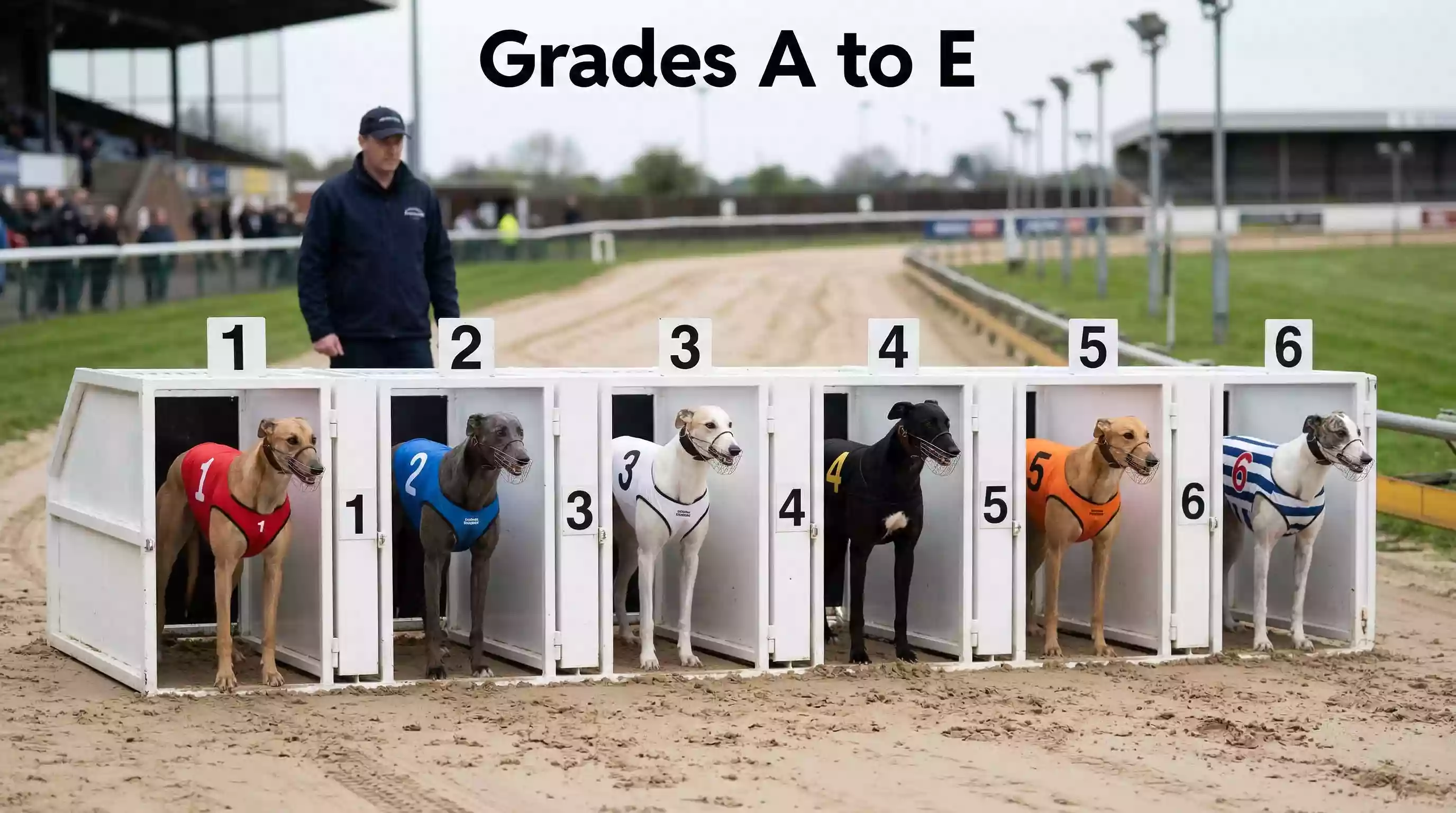
Every greyhound race staged at a GBGB-licensed track in Britain is graded. The grading system exists for a simple reason: competitive balance. Without it, the fastest dog in the kennel would win every race by ten lengths, the betting market would collapse, and the sport would lose its point. Grades A through E ensure that dogs of similar ability run against each other, which keeps the racing close, the results uncertain, and the form data meaningful.
The system is not complicated in principle, but it has enough moving parts to confuse anyone encountering it for the first time. Grades are track-specific, determined by the racing manager at each stadium, and based primarily on a dog’s recent times. A dog graded B2 at Sunderland is not necessarily the same standard as a B2 at Romford, because each track sets its own grade boundaries based on its own distances and surface.
If you are trying to read greyhound results with any precision, understanding the grading system is not optional. It is the frame that gives every finishing time and every finishing position its context.
The Grade Ladder — A Through E
The grade ladder runs from A at the top to E at the bottom, with most tracks using numbered subdivisions within each letter. A typical hierarchy at a stadium like Sunderland might look like this: A1 (fastest), A2, A3, then B1, B2, B3, and so on down through C, D and into E grades. Not every track uses every subdivision — smaller stadia with fewer dogs may compress the scale — but the principle is consistent across all eighteen GBGB-licensed venues in Britain.
Grade A dogs are the elite. These are greyhounds posting the fastest calculated times over the track’s primary distances, and they race for the highest prizes. At a track like Sunderland, which hosts two Category One events, A-grade fields on open-racing nights can feature dogs competing at near-national standard. The form lines from these races carry the most weight in any cross-track comparison.
Grade B is the step below — solid, competitive dogs that may be a length or two off the top grade but are capable of stepping up on their night. B-grade races often produce the tightest finishes, because the field quality is high enough for genuine competition but not so stratified that one dog dominates.
Grades C and D are where the volume is. The majority of races on a BAGS card will be graded somewhere in this range, and the majority of active racing greyhounds in Britain spend most of their careers here. These are honest, sound dogs that may lack the raw speed for the upper grades but race consistently within their level.
Grade E is the entry point and the safety net. Maiden greyhounds — dogs that have never won a race — typically start here, alongside older dogs that have dropped down through the grades over time. Favourites in lower-graded races tend to win more reliably: across all UK tracks in 2024, the favourite won 35.67% of graded races on average, but that figure fluctuates by grade, with lower tiers generally showing higher favourite strike rates due to wider ability gaps in the field.
How Dogs Move Between Grades
Greyhounds do not stay in one grade forever. The system is designed to move dogs up or down based on recent performance, and the racing manager at each track is the person who makes those calls. The process is part science, part craft: times and finishing positions provide the raw data, but the racing manager also considers factors like trouble in running, trap draw disadvantages, and whether a dog is clearly improving or declining.
Promotion happens when a dog wins or runs fast enough to suggest it belongs at a higher level. The trigger is usually a calculated time — the adjusted time that strips out going allowance and other variables — that falls within the boundary for the next grade up. Win two races in succession at B3 level with times that match A3 criteria, and you will likely find yourself promoted before the next meeting.
Relegation works the same way in reverse. A string of below-par performances, a noticeable drop in time, or consistent finishing positions in the bottom half of the field will see a dog moved down. This is not a punishment — it is a recalibration. A dog that cannot compete at B grade will get beaten repeatedly, which is bad for the animal’s confidence and bad for the betting market. Dropping it to C grade gives it a chance to win again and restores competitive balance to both grades.
Open races sit outside the grading structure entirely. These are invitation-only events — typically the highest-quality races on the card — where entry is based on form and reputation rather than grade. Category One events like the Premier Classic at Sunderland are open races: the best available dogs, regardless of grade, competing for the biggest prizes. An open race result tells you something different from a graded race result, because the field is not artificially levelled. The finish order in an open race is a purer measure of absolute ability.
One quirk worth knowing: grading is track-specific. A dog that is A-graded at a smaller track may only warrant a B or even C grade at a larger, more competitive stadium. This is why cross-track form comparison is tricky — the letter grade alone does not tell you enough. You need to look at the times, the going, and the company the dog was keeping.
See also Forecast and Tricast Betting in Greyhound Racing.
Why Grading Matters for Reading Results
A finishing time without a grade is almost meaningless. Consider two dogs that both post 28.30 seconds over 450 metres at Sunderland. One did it in an A2 race, the other in a D3. The A2 dog ran that time against five opponents of near-equal ability, likely under pressure from trap to line. The D3 dog may have led from the first bend in a weaker field with no serious challenger. Same time, entirely different achievement.
This is why grade context is the first thing an experienced form reader looks for when scanning a result sheet. The grade tells you the standard of opposition. The finishing position tells you how the dog performed relative to that standard. And the time tells you whether the performance was fast, slow or middling for that grade on that day’s going. All three pieces of information need each other to make sense.
Grade changes between runs are also significant. A dog that was graded B3 last week and appears on this week’s card at A3 has been promoted — the racing manager saw enough in recent performances to move it up. That is a positive signal, but it also means the dog is about to face stiffer competition. Whether it can handle the step up is the question, and the result of its first run at the higher grade carries more analytical weight than three routine wins at the lower level.
The total UK prize fund for greyhound racing stands at approximately £15.7 million, and the distribution of that money follows the grading structure. Open races and A-grade events command the highest purses; E-grade races receive the least. For trainers, the grading system is not just about competition — it is about economics. A dog that can sustain an A-grade career earns significantly more than one that spends its time in the lower tiers, which is why grade promotion matters beyond the numbers on a result sheet.
For anyone trying to make sense of Sunderland’s results, the practical takeaway is straightforward: always check the grade before you assess the performance. A third-place finish in an A1 race may represent a better run than a first-place finish in a D4. The grading system exists to level the playing field, but it also provides the analytical framework that makes form study possible. Greyhound Grading System UK — More on this topic at sunderland greyhound results.
