Greyhound Going Allowance — How Track Conditions Change Race Times
Best Horse Racing Betting Sites – Bet on Horse Racing in 2026
 Available in US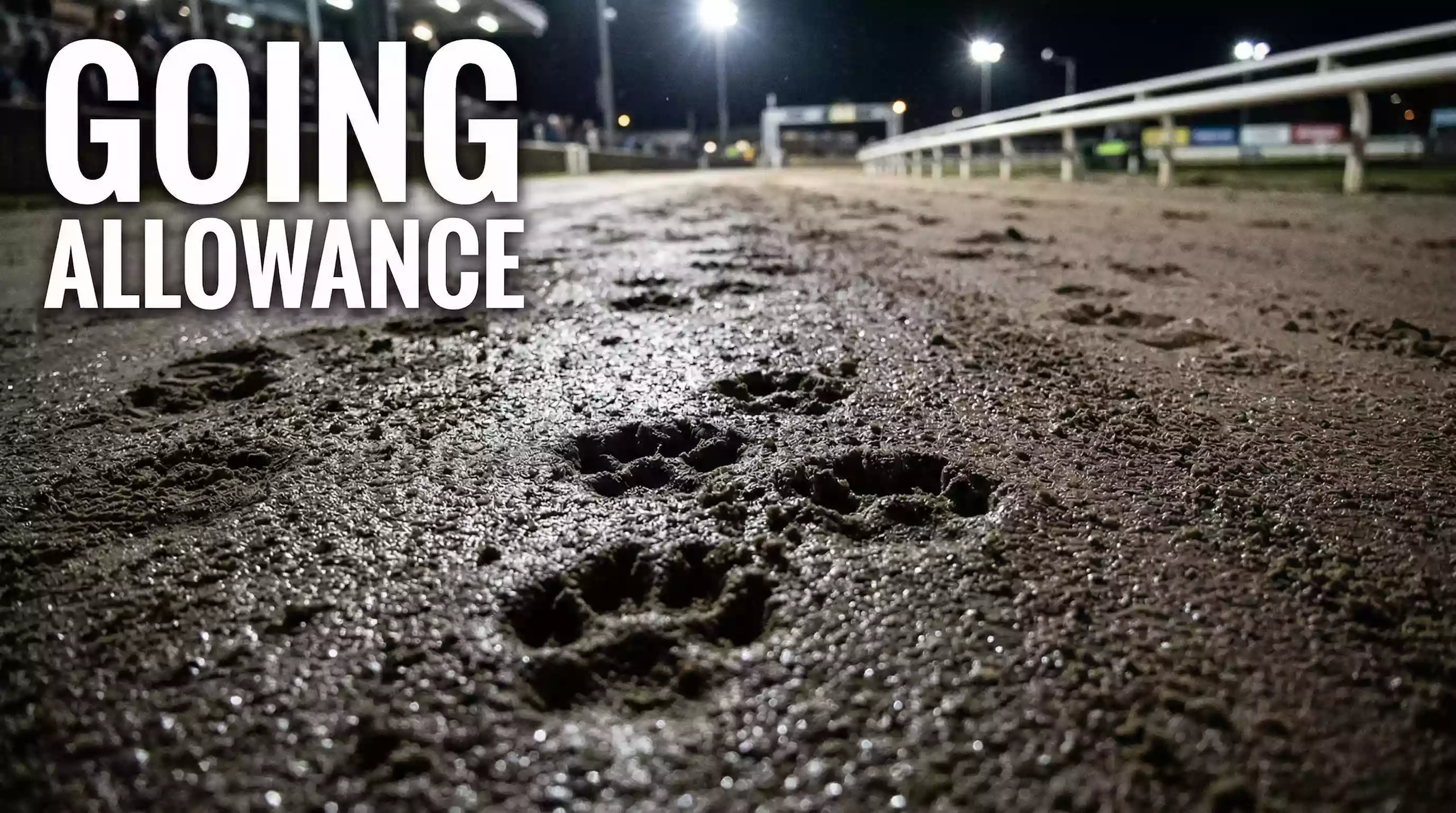
Going allowance is the adjustment that makes greyhound race times comparable across different meetings. Without it, a dog that runs 28.40 seconds over 450 metres on a heavy, rain-soaked track looks slower than one that runs 28.20 on a dry, fast surface — even though the first dog may have produced the better performance. The going allowance corrects for that difference by translating every actual race time into a standardised figure that reflects the dog’s ability rather than the conditions underfoot.
It is one of the most important numbers on a greyhound result sheet, and one of the most overlooked. Casual punters compare raw times. Serious form students compare calculated times — which means they need to understand how the going allowance works, what it measures, and where its limitations lie.
What “Going” Means at a Greyhound Track
Greyhound tracks in Britain run on sand — not turf, not dirt, but a specifically graded sand surface that is maintained by the track groundstaff before and during every meeting. The condition of that surface is what “going” refers to, and it changes depending on several factors that are largely beyond anyone’s control.
Moisture is the biggest variable. A dry track is fast. The sand is firm, compacted by regular use, and the dogs’ feet get good purchase with minimal slippage. A wet track is slow. Rain saturates the sand, makes it heavier, and creates a surface that absorbs energy with every stride. The difference between a fast, dry surface and a heavy, waterlogged one can be worth several lengths over a standard 450-metre race — enough to transform the form book.
Temperature plays a secondary role. Cold conditions tend to firm up the surface, while warm weather can dry out sand that was damp at the start of the meeting. Wind has a marginal effect, particularly on exposed tracks, though it is not formally factored into the going calculation at most venues.
Track maintenance is the controllable variable. GBGB requires all licensed tracks to meet specific surface standards, and the regulatory body has doubled its programme of expert inspections in recent years — STRI (Sports Turf Research Institute) specialists now visit tracks on a quarterly basis, up from twice a year previously. These inspections monitor sand depth, compaction, drainage and consistency, ensuring that the base surface meets a uniform standard. But even with diligent maintenance, no two meetings run on identical going, because weather is the dominant factor and weather does not repeat itself.
The going is assessed by the racing manager before each meeting and expressed as a number: the going allowance. Standard going — a dry, fast surface in normal conditions — is set at zero. Everything else is measured relative to that baseline. A going allowance of +20 means the track is twenty hundredths of a second slower than standard per unit distance. A going of -10 means the surface is faster than standard. The number is published on the result sheet and applied uniformly to every race on that card.
How the Allowance Is Applied
The formula for converting a raw race time into a calculated time is straightforward: actual time minus the going allowance equals calculated time. If a dog runs 28.60 seconds over 450 metres on a night where the going allowance is +20 (meaning the track is 0.20 seconds slow), the calculated time is 28.40 seconds. That 28.40 figure is what you compare against other dogs’ calculated times — it represents what the dog would have run on a standard surface.
When the going is negative — faster than standard — the adjustment works in the other direction. A raw time of 28.10 on a going of -10 produces a calculated time of 28.20. The dog ran faster than it “should” have on standard going, so the calculation adds time back to normalise the figure.
The going allowance is applied per race distance, not per bend or per section. This is a simplification, because in reality different parts of the track may be affected by weather differently — a bend that sits in shadow may dry slower than the home straight — but the single-number approach is the accepted standard across all GBGB tracks and has the advantage of being simple to apply and simple to understand.
There is one nuance that catches people out. The going allowance is assessed at the start of the meeting and applies to all races on the card. But track conditions can change during a meeting — afternoon rain stopping, the surface drying under floodlights, sand being raked between races. A dog that runs in race 12 may encounter a slightly different surface from one that ran in race 1, yet both carry the same going allowance. This is a known limitation, and experienced form readers account for it by noting the race number alongside the calculated time.
The current 640-metre track record at Sunderland — 38.79 seconds, set by New Destiny in the 2025 ARC Grand Prix — was run on near-standard going, which is partly why it stands as such a meaningful benchmark. Records set on fast going are sometimes viewed with a degree of scepticism, because the surface flattered the performance. A record on standard going is harder to argue with.
See also Greyhound Trap Bias.
Practical Use — Comparing Dogs Across Meetings
The primary use of going allowance in form assessment is comparison. You want to know whether Dog A is faster than Dog B over 450 metres. Dog A ran 28.50 last Friday at Sunderland on +15 going (calculated time 28.35). Dog B ran 28.30 the previous Wednesday on -10 going (calculated time 28.40). The raw times suggest Dog B is faster. The calculated times say Dog A is — by five hundredths of a second. That five hundredths may not sound like much, but in a sport where the winning margin is often a neck or a short head, it can be decisive.
Cross-meeting comparison only works if you trust the going assessment. And here is where the system’s subjectivity becomes relevant. The going allowance is set by a human being — the racing manager — based on their assessment of the track surface at a specific time. Two different racing managers might assess the same conditions differently. A track that has been well-maintained and recently re-sanded will behave differently from one at the end of a long racing week. The GBGB’s expanded STRI inspection programme helps standardise surfaces across tracks, but the going assessment itself remains a judgment call.
For practical form study, the best approach is to use calculated times as the primary comparison metric while keeping two caveats in mind. First, compare like with like — calculated times over the same distance at the same track are the most reliable comparisons. Cross-track calculated times introduce additional variables (different circumferences, different run-up distances, different sand types) that the going allowance does not account for. Second, treat going allowances at the extremes with extra caution. A going of +40 or higher suggests unusually heavy conditions where the surface itself may have been inconsistent across races, making the single-number adjustment less reliable.
Going allowance is not a perfect system. It is an approximation — a single number applied to a complex, variable surface to make the form book usable. But it is the best tool available, and any attempt to compare greyhound times without adjusting for going is a comparison built on sand, in every sense of the phrase. Greyhound Going Allowance — More on this topic at sunderland greyhound results.
