Greyhound Racing Abbreviations UK — The Complete Glossary from SAw to W
Best Horse Racing Betting Sites – Bet on Horse Racing in 2026
 Available in US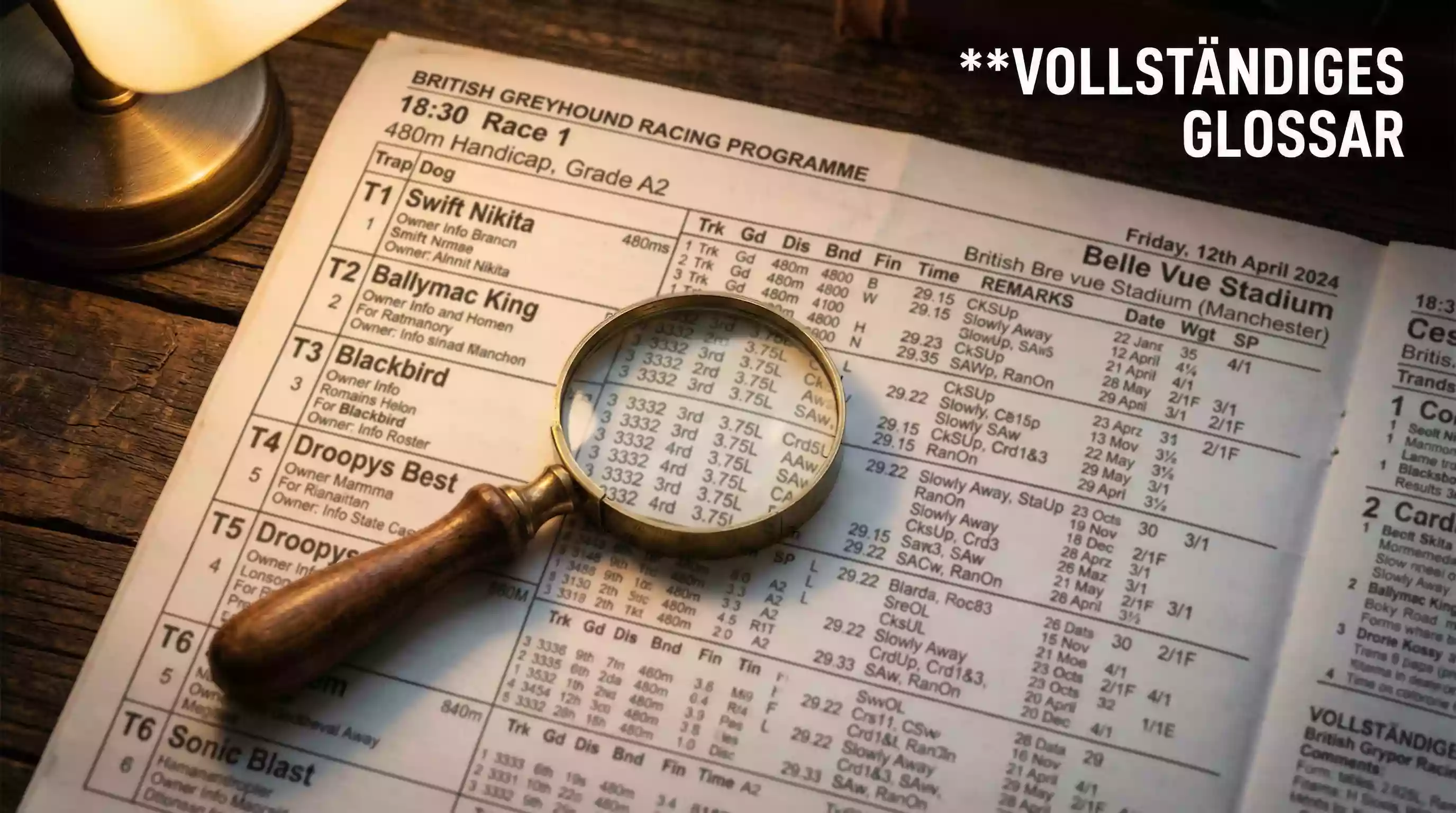
UK greyhound results compress an entire six-dog race into a single line of shorthand. A finishing comment like “EP,Ld1-Crd3,RnIn” tells an experienced reader exactly what happened — the dog showed early pace, led from the first bend, was crowded at the third bend, and ran on to finish. For anyone without the codebook, it reads like noise.
There are over forty standard greyhound racing abbreviations used across GBGB-licensed tracks in Britain. They cover every phase of a race — from the moment the traps open to the instant the first dog crosses the line — plus a set of administrative codes for non-runners, disqualifications and voided results. This glossary lists them all, grouped by race phase, with a plain-English explanation of what each one means and when you will see it on a result sheet.
See also Arena Racing Company and Sunderland.
Start-Phase Abbreviations
The start is the most compressed phase of a greyhound race. At tracks like Sunderland, where the run-up to the first bend is 93 metres on the 450-metre distance and 84 metres on the 640-metre distance, what happens in those opening seconds often determines the entire race shape. The abbreviations for this phase tell you how cleanly a dog left the traps and what position it held by the time the field reached the first turn.
SAw — Slow Away. The dog was slow out of the traps. This is the most common start-phase note and can mean anything from a fractional hesitation to a badly missed break. A dog marked SAw has lost ground at the point where ground is hardest to recover.
QAw — Quick Away. The opposite. The dog left the traps sharply and gained an early advantage. In sprint races over 261 metres, QAw is often the difference between winning and finishing mid-pack.
VQAw — Very Quick Away. An emphatic trap exit. This dog did not just break well — it broke noticeably faster than the rest of the field. Rare to see, but significant when it appears.
MsdBrk — Missed Break. More severe than SAw. The dog stumbled, hesitated badly or was left standing when the lids opened. A missed break at 261 metres is usually terminal for that race.
EPace or EP — Early Pace. The dog showed speed in the opening phase, typically reaching the first bend in one of the leading positions. This does not necessarily mean it led — just that it was prominent early.
SLd — Soon Led. The dog took the lead shortly after the traps opened and held it into the first bend. Stronger than EP — this dog was in front, not just near the front.
Led1 — Led at the first bend. A positional marker confirming the dog was in front at a specific point. You will also see Led2, Led3 and Led4 for subsequent bends, and LedRnIn for leading on the run to the line.
Mid-Race Abbreviations
Mid-race abbreviations describe what happens between the first bend and the final straight. This is where crowding, bumping and positional changes create the story of the race. A clean mid-race run with no trouble comments usually means a dog had a clear passage — which makes its finishing time more reliable for form assessment.
Crd — Crowded. The dog was squeezed by one or more opponents, losing momentum and often ground. Crd1, Crd2, Crd3, Crd4 specify the bend where it happened. Crowding at the first bend is more common than at later stages, because six dogs are funnelling into the same tight space.
Bmp — Bumped. Physical contact with another dog. More forceful than crowding — the dog was knocked sideways or checked. Bmp1, Bmp2 etc. locate the incident. A dog marked Bmp at a key bend may have lost several lengths.
BCrd — Badly Crowded. A severe version of Crd. The dog was significantly impeded, potentially losing all chance of a competitive finish. This is a red flag in form assessment — any time figure from a BCrd race should be treated with caution.
Ck — Checked. The dog had to adjust its stride or change direction to avoid trouble. Less severe than Bmp but still a meaningful interruption. CkRnUp means the dog was checked on the run-up to the first bend.
MsPace or Mid — Mid-division pace. The dog was running in the middle of the pack, neither prominent nor trailing. A neutral marker — neither good nor bad in isolation.
Wide — Ran Wide. The dog drifted or was pushed to the outside of the track on a bend. At Sunderland, which uses an Outside McGee hare, running wide can mean a longer route around the bend but also a cleaner passage away from the rail-side congestion.
RIs — Raced in Spots. An inconsistent mid-race effort — the dog showed pace in patches rather than sustaining it. Often indicates a dog that is either not fully fit or not suited to the distance.
Blk — Baulked. The dog’s path was blocked by another runner, forcing it to check or change course. Similar to Ck but implies a more complete stoppage of forward momentum.
Finish and Result Abbreviations
Finish abbreviations cover the closing stages — from the final bend to the line — and the outcome itself. These are the comments that tell you how a dog finished the race: whether it was closing, holding on, or fading.
RnIn — Ran In. The dog stayed on down the final straight, maintaining its effort to the line. Not quite the same as finishing strongly — RnIn implies competent finishing without a dramatic late surge.
FinWell — Finished Well. Stronger than RnIn. The dog was gaining ground in the closing stages and hit the line with momentum. A dog marked FinWell over 450 metres might be worth watching over 640 metres, where its late pace could be an advantage.
RnOn — Ran On. Similar to FinWell — the dog kept finding more in the closing stages. Often used for dogs that were behind at the last bend but closed the gap impressively before the line.
Ld — Led. The dog was in front at the relevant point. When used near the finish, it confirms the dog held the lead through the closing stages. LdNrLn means the dog took the lead near the line — a last-gasp victory.
NrLn — Near the Line. A positional qualifier. Often paired with other comments: LdNrLn (led near the line), CghtNrLn (caught near the line). The latter is particularly telling — a dog that led most of the race but was caught at the death may have tired, or the winner may simply have been faster in the final fifty metres.
Won — Won the race. Simple enough. The margin of victory is usually expressed in lengths alongside this: “Won 2L” means the dog won by two lengths.
DH — Dead Heat. Two or more dogs crossed the line at precisely the same instant. Dead heats are settled by dividing the relevant prize money and dividends. In terms of the Trap 1 win-rate data that sits at 18 to 19 percent nationally — versus the theoretical 16.6 percent baseline — a dead heat involving the rail runner still counts as a partial win in the statistics.
Non-Race Codes
Not every dog that appears on a racecard actually runs. Administrative codes on the result sheet explain what happened and why a dog did not participate, or why its result was altered after the race.
NR — Non-Runner. The dog was declared to run but was withdrawn before the race. Reasons vary: injury discovered at the kennels, a failed weight check, a late veterinary decision. An NR voids any bets placed on that dog. If the race is reduced to five runners, the tricast is also voided.
Dis — Disqualified. The dog ran but was disqualified after the race, usually for interference. A disqualified dog is removed from the finishing order, and the places below move up. Forecast and tricast dividends are recalculated to reflect the revised order.
RE — Refused to Race. The dog was in the traps when the lids opened but did not chase the hare. This is uncommon but not unheard of, particularly with young dogs in their first few races. RE is treated differently from NR — the dog was technically a participant, but bets are usually voided depending on GBGB rules and the individual bookmaker’s terms.
Void — Race Voided. The entire race was declared void, usually because of a hare malfunction, a trap failure, or some other technical issue that compromised the fairness of the competition. All bets on a void race are returned.
Ret — Returned. Used in some result formats to indicate a dog that was returned to its kennel without racing, typically due to a veterinary inspection finding an issue after the dog had been weighed in.
These codes appear less frequently than in-running comments, but they are essential for accurate record-keeping. A form reader who ignores an NR or a Dis in a dog’s recent history is working with incomplete information — and in a sport where the margin between getting it right and getting it wrong is measured in fractions of a second, incomplete information is a luxury nobody can afford. Greyhound Racing Abbreviations UK — More on this topic at sunderland greyhound results.
