Greyhound Trap Bias — Does Starting Position Really Create an Advantage?
Best Horse Racing Betting Sites – Bet on Horse Racing in 2026
 Available in US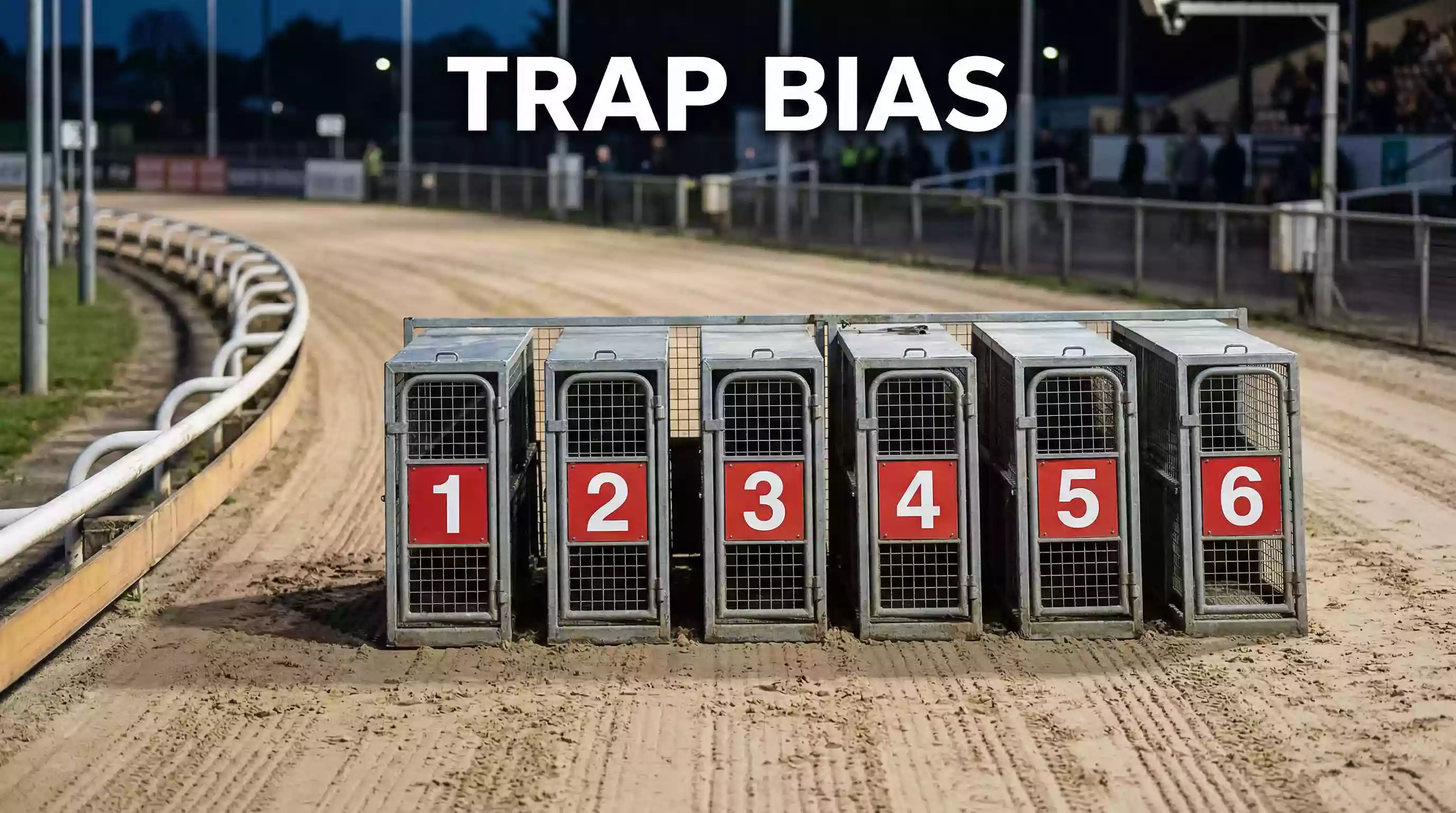
Six traps, one inside rail, and a mechanical hare running on the outside. If greyhound racing were perfectly fair, each starting position would produce a winner exactly one-sixth of the time — 16.6 percent across a large enough sample. In reality, the numbers deviate from that baseline at every track in Britain, and the pattern of deviation is consistent enough to suggest that trap position does create an advantage. The question is whether the advantage is geometric — a product of track design — or a side effect of how racing managers assign dogs to traps.
The trap bias debate has been running as long as greyhound racing itself. Punters study it obsessively. Trainers lobby for favourable draws. Racing managers insist the system is fair. The data, as usual, sits somewhere between the competing narratives and tells a more nuanced story than any of them would prefer.
The Theoretical Baseline — 16.6%
The 16.6 percent baseline is simple arithmetic. Six dogs, one winner, equal probability for each: 100 divided by 6 gives 16.67 percent. If traps were assigned randomly, if every dog were identical in ability, and if the track geometry treated all six positions equally, you would expect each trap to produce winners at almost exactly that rate over a season’s worth of races.
None of those conditions hold. Dogs are not identical — they vary in pace, running style and temperament. Traps are not assigned randomly — racing managers seed them based on a dog’s running style and recent form. And the track geometry does not treat all positions equally, because the inside rail is closer to the first bend and the hare runs on one side or the other, creating an asymmetry that favours certain lines.
Across all UK tracks, Trap 1 shows a win rate of approximately 18 to 19 percent — roughly two percentage points above the theoretical baseline. The explanation most commonly offered is the protected-flank effect: the dog in Trap 1 has the inside rail to its left and only needs to worry about pressure from one side. Every other trap faces potential interference from both sides during the initial break and the approach to the first bend. That one-sided protection gives the Trap 1 runner a fractionally cleaner path, and over thousands of races, fractions add up.
The outer traps — particularly Trap 5 and Trap 6 — tend to sit at or slightly below the baseline, though the pattern varies by track. The dogs in wider positions have more ground to cover on the first bend and are more vulnerable to being squeezed by rivals breaking inward. The disadvantage is not dramatic on any single race, but it is persistent enough to show up in the aggregate data.
Track-Specific Variation
The national average disguises significant variation between tracks. Towcester, for instance, shows a Trap 1 win rate of around 20 percent — a substantial advantage in a six-runner sport. At the other end of the spectrum, Harlow produces a Trap 6 win rate of approximately 21 percent, which turns the usual inside-rail narrative on its head.
What drives these differences? Three factors dominate: track geometry, hare type and the distance from traps to the first bend.
Track geometry is about circumference and bend radius. A tighter track compresses the field on the bends, which amplifies the advantage of being on the rail. A wider track gives outside runners more room to hold their line without losing ground. Sunderland’s 379-metre circumference puts it in the mid-range — neither the tightest nor the most spacious circuit on the UK schedule.
Hare type is the variable most people overlook. At tracks with an inside hare, dogs naturally cut toward the rail to follow the lure, which creates congestion on the inside and can actually benefit wider runners who avoid the crowd. At tracks with an outside hare — like Sunderland’s Outside McGee system — dogs are drawn toward the outer rail, which changes the dynamic at the first bend. The interaction between hare position and trap draw is different at every track, and it is the primary reason that trap bias data from one venue cannot be transplanted to another.
Run-up distance — the stretch from the traps to the first bend — determines how much time the field has to sort itself out before the bend arrives. A long run-up allows dogs to find their position and reduces first-bend congestion. A short run-up compresses everything into a smaller space and magnifies the importance of trap position. Sunderland offers 93 metres of run-up on the 450-metre distance and 84 metres on the 640-metre distance — respectable but not generous, which means trap draw matters more here than at tracks with longer straight approaches to the first turn.
The upshot is that trap bias is real but local. A blanket rule like “always back Trap 1” will make you money at some tracks and lose you money at others. The data has to be track-specific to be useful.
See also Sunderland Greyhound Trainers.
Is It Bias or Is It Grading?
Here is where the debate gets interesting. Racing managers do not assign traps at random. They seed them based on a dog’s running style — early-pace dogs tend to be drawn on the inside, where they can use their speed to reach the first bend in front; wide-running dogs are drawn on the outside, where they have room to hold their natural line. This is not supposed to create bias. It is supposed to create fair, competitive racing by matching each dog to the trap that suits its style.
But seeding complicates the data. If Trap 1 consistently receives dogs with strong early pace — dogs that would have a high win probability regardless of starting position — then Trap 1’s elevated win rate might reflect the quality of the dogs placed there, not a geometric advantage. Separating genuine track bias from the effect of intelligent seeding is the central analytical problem, and it does not have a clean solution.
One way to test it is to look at open races, where the racing manager has less influence over trap draws and the fields are more randomly constituted. If Trap 1 still wins at elevated rates in open races, that points toward genuine geometric bias. If the advantage disappears, it suggests the seeding effect is dominant. The available data, drawn from studies across multiple tracks, leans toward a combination: there is a real geometric advantage for the inside traps, but it is amplified by the seeding process.
The national favourite win rate of 35.67 percent across all graded races in 2024 provides useful context here. Favourites are identified by the betting market, not by trap position — but trap position does influence favouritism. A dog drawn in Trap 1 at a track with known inside bias is more likely to be sent off as favourite, and favourites win more often than non-favourites. The relationship between trap draw, market favouritism and actual winning probability is circular, and untangling it requires more data than most casual analysts are prepared to gather.
For practical purposes, the takeaway is this: greyhound trap bias exists, it varies by track, and it interacts with the grading and seeding system in ways that make the raw trap win-rate data slightly misleading. Use it as one input among several — alongside form, going, distance suitability and running style — rather than as a standalone selection tool. The dogs do not know which trap they are in. They just run. Greyhound Trap Bias — More on this topic at sunderland greyhound results.
