Sunderland Greyhound Racing History — From the 1940 Opening to the Modern Era
Best Horse Racing Betting Sites – Bet on Horse Racing in 2026
 Available in US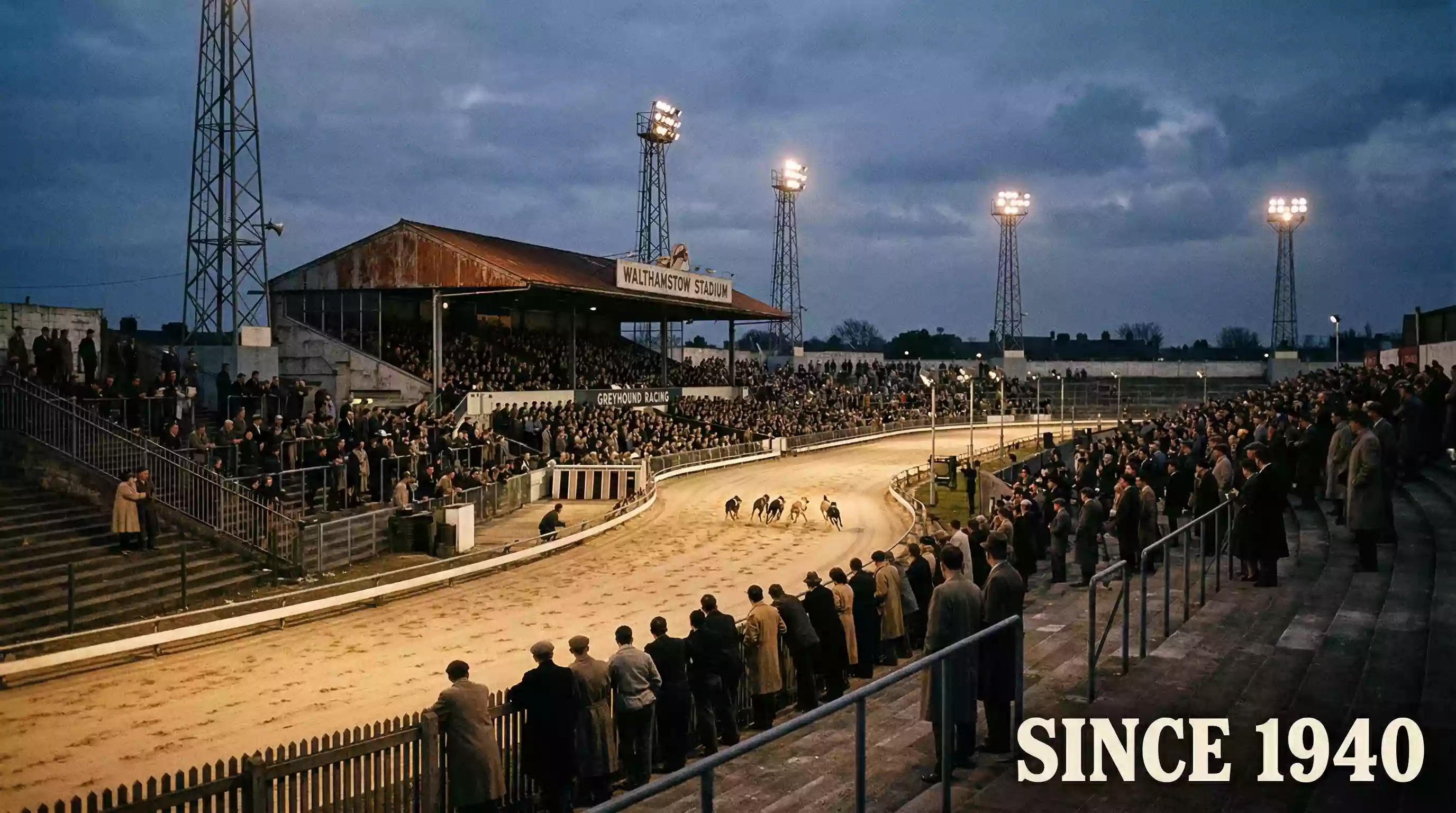
Sunderland greyhound stadium opened its gates on 23 March 1940. Built for £60,000 — a serious investment in wartime Britain — the track on Sunderland Road was designed by Matkin and Hawkins and entered a sport that was, at that point, barely fourteen years old. Greyhound racing had only arrived in Britain in 1926, and the boom that followed had already produced dozens of tracks across the country. Sunderland was late to the party, but it arrived with ambition.
Eighty-six years later, the stadium is still racing. That simple fact is its most remarkable credential. Hundreds of British greyhound tracks have opened and closed in the intervening decades — 91 NGRC-licensed venues shut between 1960 and 2010 alone. Sunderland outlasted them all. Its history is not one of continuous triumph; it is a story of survival through reinvention, ownership changes and a sport that has spent more time declining than growing.
The Early Decades — 1940s to 1960s
The timing of Sunderland’s opening was not ideal. March 1940 was six months into the Second World War, and the country had rather more pressing concerns than greyhound racing. But the sport had proven itself recession-proof during the 1930s, and promoters betting on a quick war — or at least on the public’s need for cheap entertainment during a long one — pressed ahead with construction.
The context matters. By 1940, Britain had 77 licensed greyhound tracks and over 200 independent venues, 33 of them in London alone. The sport had exploded from its first meeting at Belle Vue, Manchester in 1926 to become one of the most attended spectator events in the country. Attendance figures from the late 1920s tell the story: 5.5 million in 1927, surging to 13.7 million in 1928 and 16 million by 1929. Greyhound racing was not a niche pursuit — it was mass entertainment, and new tracks were being built to meet insatiable demand.
Sunderland entered this market at its wartime plateau. Racing continued throughout the conflict — one of the few sports to do so consistently — and the post-war years brought a second boom. The 1940s and 1950s were arguably the golden era for British greyhound tracks: large crowds, healthy betting turnover, and a social status that placed a night at the dogs somewhere between the football and the music hall.
The north-east had its own racing culture, distinct from the London circuit. Tracks in Sunderland, Newcastle and other industrial towns drew working-class crowds who came as much for the social occasion as for the betting. The stadium on Sunderland Road became a fixture in the local calendar — a Friday night out that passed from one generation to the next.
By the early 1960s, though, the landscape was changing. Television was pulling crowds away from live events. Betting shops, legalised in 1961, meant punters no longer needed to be at the track to have a wager. The post-war attendance boom faded, and tracks began to close. Between 1960 and 2010, ninety-one NGRC-licensed greyhound tracks shut their doors permanently — a rate of roughly two closures per year, sustained across five decades. Sunderland survived, but the decades of easy money were over. The stadium that had opened into a booming industry now found itself in a shrinking one, and the challenge of staying open would define the rest of its history.
The Speedway Years — 1964 to 1974
In 1964, with greyhound-only revenue declining, the stadium took on a second identity. Speedway arrived at Sunderland Road, and for the next decade the track operated as a dual-use venue — dogs on some nights, motorcycles on others.
The speedway teams changed names and leagues with a frequency that reflected the precarious economics of the sport. The Sunderland Saints launched in 1964, attracting crowds of up to 6,500 — a figure that dwarfed anything greyhound racing was pulling in at the time. The Saints were followed by the Sunderland Stars in the early 1970s, and then the Gladiators. Each incarnation competed in different tiers of the speedway league structure, and each brought its own following to a stadium that was designed for greyhounds, not motorcycles.
Running both sports from the same venue was a logistical compromise. The greyhound track surface was sand; speedway required shale or dirt, laid inside the dog track on a tighter oval. Scheduling had to keep the two disciplines apart, and the physical demands of maintaining two racing surfaces on the same site were considerable. But the additional revenue from speedway helped subsidise the greyhound operation during a period when standalone tracks were closing at an alarming rate.
Speedway left Sunderland in 1974. The economics had shifted again — crowds fell, costs rose, and the dual-use model was no longer sustainable. The stadium reverted to greyhound-only operation and has remained so ever since. The speedway decade left no permanent mark on the track itself, but it is a chapter worth knowing, because it illustrates the kind of commercial flexibility that has kept the venue alive where others failed.
See also Greyhound Going Allowance.
William Hill, ARC and the Modern Stadium
The next major shift came in September 2002, when William Hill paid £9.4 million for Sunderland greyhound stadium — the first time a national bookmaker had bought a greyhound track outright. The acquisition was strategic: William Hill wanted control of its own racing content, and Sunderland gave them a stadium that could generate a regular schedule of BAGS meetings for their betting shops. The price tag, eye-catching for a greyhound venue, reflected the value of the media rights as much as the physical asset.
Under William Hill, Sunderland continued to operate smoothly but without significant investment in the leisure side of the business. The stadium was functional, the racing consistent, and the BAGS contracts reliable. But the focus was squarely on content generation for the betting market, not on developing the venue as a destination.
That changed in May 2017, when Arena Racing Company acquired both Sunderland and Newcastle from William Hill. ARC brought a different philosophy — one that treated greyhound stadiums as leisure venues first, with betting as a component rather than the entire purpose. Investment went into restaurant refurbishment, marketing campaigns, corporate hospitality packages and a push to grow Friday-night attendance. The Back On Track initiative and the elevation of Sunderland to host two Category One events — the Premier Classic and the ARC Grand Prix — signalled a new level of ambition for the track.
The most dramatic recent moment came on Good Friday 2025, when New Destiny broke the 640-metre track record with a time of 38.79 seconds during the ARC Grand Prix final, trained by champion trainer Mark Wallis. The previous year, part-time trainer Richard Wales had won the same event with Farneys Willie — only weeks after obtaining his GBGB licence. Wales described the experience as the best feeling he had ever had. These moments capture what Sunderland’s modern era is about: a stadium with deep roots, backed by corporate investment, still capable of producing stories that make the sport worth following.
As the centenary of UK greyhound racing approaches in 2026, Sunderland’s position is unusual. It is one of the oldest surviving tracks in the country, yet its current operation is thoroughly modern — ARC-backed, media-integrated, and more commercially oriented than at any point in its history. Whether that is enough to sustain the stadium for another eighty-six years is anyone’s guess. But the first eighty-six are on the board. Sunderland Greyhound Racing History — More on this topic at sunderland greyhound results.
