UK Greyhound Betting Turnover and Industry Economics — Where the Money Goes
Best Horse Racing Betting Sites – Bet on Horse Racing in 2026
 Available in US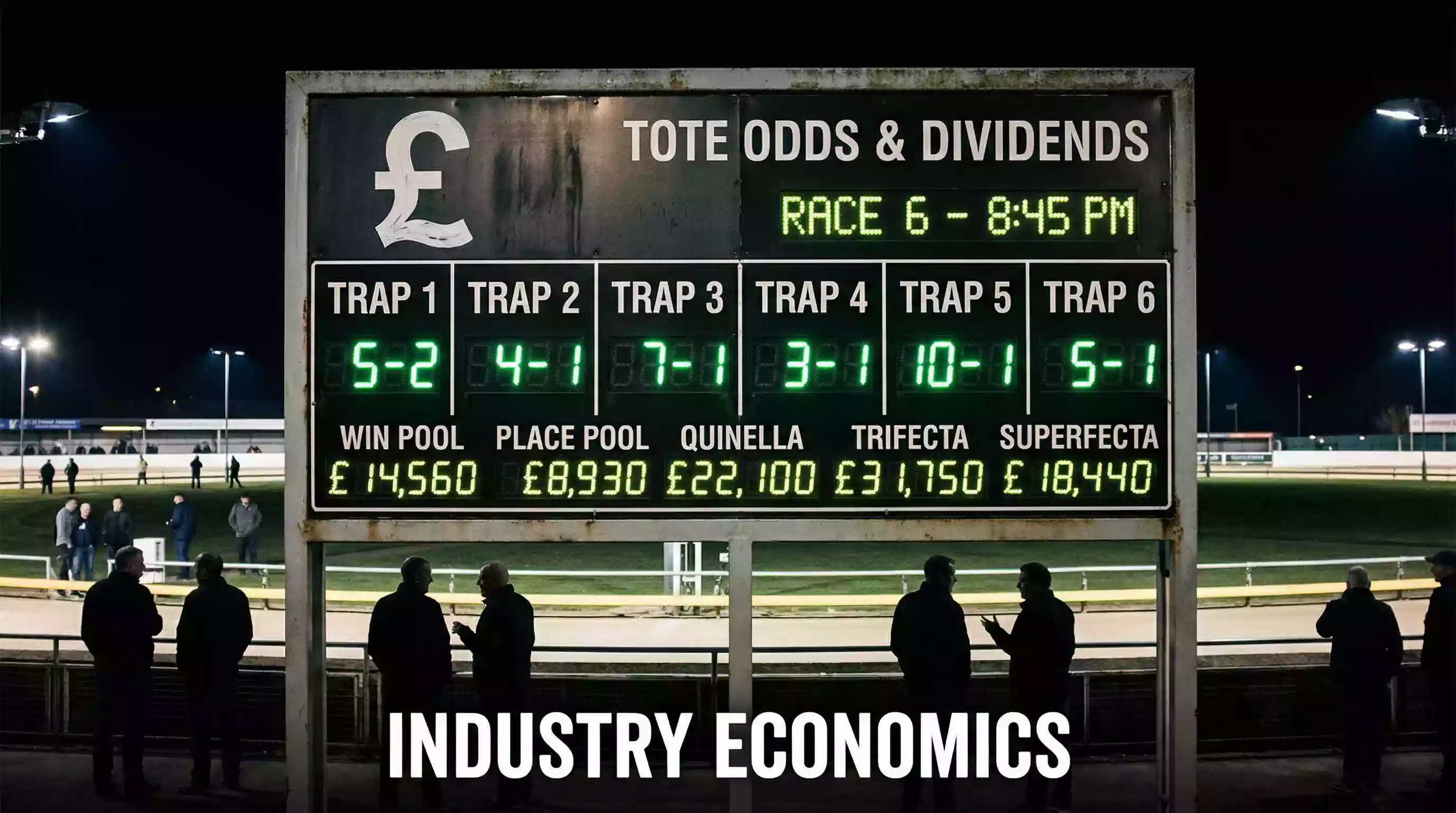
Bookmakers turned over approximately £794 million on UK greyhound racing in the 2023-24 financial year. That is a substantial market — larger than many people assume for a sport that rarely makes the front pages. Yet the amount that flows back to greyhound racing from that turnover is a fraction of what the sport needs to sustain itself. The gap between what bookmakers earn from greyhound content and what they return to the industry is the central economic tension in UK dog racing, and it explains both the sport’s survival and its fragility.
Understanding greyhound betting turnover is not an academic exercise. It affects prize funds, welfare budgets, track maintenance, staffing levels and the viability of every licensed stadium in Britain — Sunderland included. The money trail starts with the punter’s stake and ends with a system that many inside the sport believe is broken.
Turnover, Levy and BGRF
The £794 million figure comes from Gambling Commission data and covers betting-shop turnover on greyhound racing for the year to March 2024. It does not include online-only betting, which is harder to disaggregate from total figures but would push the real number higher. By any measure, greyhound racing is a significant generator of betting activity — the second-largest animal racing sport in the UK after horse racing.
From that turnover, bookmakers contribute to the sport through a voluntary levy administered by the British Greyhound Racing Fund (BGRF). The levy rate is 0.6 percent of greyhound betting turnover, paid voluntarily by participating bookmakers. In the 2024-25 financial year, the BGRF collected approximately £6.75 million through this mechanism. The previous year’s intake was £7.3 million, down from £7.6 million the year before that. The historical peak exceeded £20 million in a single year — a figure that now feels like ancient history.
The decline has been savage in real terms. Adjusted for inflation using CPI, bookmaker contributions have fallen by 67 percent since the 2008-09 financial year. That is not a gentle erosion — it is a collapse. The levy income that once funded comfortable prize money, robust welfare programmes and investment in infrastructure now barely covers the essentials.
The “voluntary” label is the critical detail. Unlike horse racing, which benefits from a statutory levy that bookmakers are legally required to pay, greyhound racing relies on goodwill. Bookmakers can — and some do — choose not to contribute, or to contribute less than the notional 0.6 percent. There is no legal mechanism to compel payment. The result is a system in which the sport generates hundreds of millions of pounds in betting revenue for bookmakers while receiving back less than one percent, and even that one percent is shrinking.
Where the Money Goes — Prize Funds, Welfare, Operations
The BGRF distributes its levy income across three main channels: prize money contributions to tracks, welfare funding and regulatory support for the GBGB. The total UK greyhound prize fund stands at approximately £15.7 million, but not all of that comes from the levy — tracks supplement the BGRF contribution with their own commercial revenue, primarily from BAGS contracts, gate receipts and hospitality income.
Prize money is the visible output. Every race at every GBGB-licensed track carries a purse funded partly by the BGRF and partly by the track operator. The biggest single prize — the English Greyhound Derby winner’s purse of £175,000 — is an outlier; most individual race prizes are measured in hundreds rather than thousands. At Sunderland, the two Category One events (the Premier Classic at £20,000 and the ARC Grand Prix at £12,500) represent the high end of what the track offers, with regular graded and BAGS races carrying smaller purses.
Welfare funding is the less visible but arguably more important allocation. The Greyhound Retirement Scheme (GRS) and the Injury Recovery Scheme (IRS) are both funded through the BGRF and GBGB. Since 2020, the GRS has paid out over £5.6 million to homing centres, and the IRS has covered nearly £1.5 million in veterinary bills for injured dogs. These schemes are direct consequences of levy income — without the voluntary contributions from bookmakers, the financial support for retired and injured greyhounds would be dramatically reduced.
Regulatory costs — the GBGB’s operating budget for track inspections, licensing, anti-doping testing and rule enforcement — also draw on levy-funded income. Running eighteen licensed stadiums to consistent welfare and safety standards is not cheap, and the GBGB’s expanded inspection programme (including quarterly STRI track assessments) adds to the cost base every year.
The arithmetic exposes the strain. Take the £6.75 million BGRF income and divide it across prize money for roughly 53,000 races a year, welfare schemes covering thousands of retired dogs, regulatory oversight of eighteen tracks, and central administrative costs. The per-race, per-dog funding is thin. Tracks compensate by generating their own revenue through BAGS contracts, hospitality and gate receipts, but these commercial streams are themselves dependent on the betting market that the voluntary levy is supposed to regulate. The entire system runs on a circular logic that works only as long as every component holds together.
See also Premier Greyhound Racing Classic at Sunderland.
The Statutory Levy Debate
GBGB has been campaigning for a statutory levy — a legally mandated payment from bookmakers to greyhound racing — for several years. The argument is straightforward: bookmakers profit substantially from greyhound content, the voluntary system is failing, and the welfare standards the sport has worked to build cannot be sustained on declining income. Mark Bird, GBGB’s Chief Executive, has been blunt on the subject, noting that welfare progress remains under threat for as long as the levy stays voluntary and some bookmakers decline to contribute their share.
The campaign includes a public petition and lobbying of Westminster politicians. The precedent exists — horse racing’s statutory levy, established by the Betting, Gaming and Lotteries Act 1963 and updated by the Horserace Betting Levy Board, provides a model that greyhound racing advocates want replicated. The counterargument from bookmakers is that the greyhound product is less commercially valuable than horse racing, that the voluntary system has served the sport adequately, and that a statutory obligation would set an unwelcome precedent for other sports seeking a share of betting revenue.
The Welsh ban adds urgency. When the Senedd moves to outlaw greyhound racing in Wales — expected between 2027 and 2030 — the licensed track network will lose another venue and the sport’s political visibility will increase. Advocates for a statutory levy argue that a ban in one nation of the UK makes the case for proper funding in the others even more pressing, because the surviving tracks will bear a greater share of the sport’s total burden.
For tracks like Sunderland, the levy debate is not abstract. Every pound that the BGRF does not receive is a pound less for prize money, a pound less for welfare, a pound less for the infrastructure that keeps a five-night-a-week operation running. ARC’s commercial scale provides a buffer — the company can cross-subsidise from its horse racing portfolio and negotiate better media deals than an independent stadium — but the structural shortfall remains. The sport generates the betting content; the bookmakers collect the revenue; the voluntary return is a fraction of what it was fifteen years ago. Something, eventually, will have to give. UK Greyhound Betting Turnover and Industry Economics — More on this topic at sunderland greyhound results.
